Improving solar PV generation
Solar repowering cost | What determines it, process, 1 to 7 days of outage
Definition: Repowering is a method that updates the inverter, DC wiring, and monitoring systems of existing solar power generation equipment to improve power generation and O&M efficiency. Central inverters that became widespread in the early FIT period (TMEIC, ABB, Hitachi Industrial Equipment Systems, etc.) stop all strings if one unit fails, and reduced supply of repair parts is also an issue. Updating to SolarEdge MLPE enables module-level MPPT and PLM (panel-level monitoring).
Estimated downtime: 1 to 2 days for low voltage, 3 to 7 days for high voltage (during parallel construction). Nationwide support. Repowering FAQ · Construction cases · Downtime guide
Types of target inverters and a guideline for cost consultation
Inverters that are likely candidates for replacement
- Large central inverters such as TMEIC, ABB, and Hitachi Industrial Equipment Systems
- Inverters from minor brands in Japan and overseas, or inverters with difficult-to-source parts
- Inverters for which cost management is difficult due to aging and rising repair costs
- Equipment installed in the early FIT period (around 2012 to 2015)
Cost considerations
- Costs vary depending on system capacity (kW), string configuration, and whether DC wiring needs to be re-run
- If the update to SolarEdge is assumed, an estimate can be prepared if the existing inverter configuration information (number of units, capacity, and condition of the combiner boxes) is available
- We also provide financial simulations comparing increased revenue from improved power generation with the costs
What determines the cost of solar repowering
When looking up “solar repowering cost,” what you want to know first is not a price list, but the conditions that change the estimate. At I-S3, we organize the range of preliminary estimates by the following items.
Conditions that tend to increase costs
- For high-voltage interconnection, the scope of junction box and distribution board updates is broad
- The new DC wiring reroute is long / the route is complex
- There are many inverters, and transport and foundations are required
- Panel replacement and mounting structure repairs are also required
- Monitoring and communications require a complete overhaul
Conditions that make it easier to keep costs down / finalize the estimate quickly
- The model number, quantity, and capacity of the existing inverters are known
- There are junction boxes, string diagrams, and monitoring screens
- A configuration that allows DC wiring to be installed in parallel while the system is operating (SolarEdge conversion)
- The outage-day constraint is clear (1 to 2 days for low voltage, 3 to 7 days for high voltage are the guideline)
Please refer to §5 for the update procedure to SolarEdge and the flow on the day of the switch. The formal amount will be provided after an on-site inspection.
For solar power consultations, starting from chat makes it easier to organize the necessary information. In chat, you can organize preliminary estimates, on-site visit schedules, and questions about repowering. If you have existing inverters, junction boxes, monitoring screens, fault history, generation data, or site photos, please send them in chat first.
Nationwide support Existing power plants nationwide Headquartered in Gunma, with many achievements in nearby prefectures. From low-voltage systems to mega-solar, you can consult us about existing facilities nationwide.
Minimum downtime Low voltage: 1–2 days / High voltage: 3–7 days Parallel work is carried out while the existing equipment remains in operation. Only the switchover requires a shutdown, minimizing lost power sales.
Improved generation Optimized at the module level SolarEdge optimizers reduce mismatches caused by shading and degradation, while also making monitoring more precise.
Integrated operation From O&M to self-consumption You can consult us about operational improvements, including remote monitoring, repairs, inspections, self-consumption conversion, and EV charging integration.
AI CHAT FIRST
Organize downtime, replacement scope, and materials for improving power generation through chat
Repowering is not just about "replacing equipment"; it is judged by considering lost electricity sales, failure risk, downtime, and future O&M as well. Organizing the documentation for existing equipment in chat makes it easier for the person in charge to proceed with the review.
Consultation on updating existing inverters We confirm based on photos and materials that show the manufacturer, capacity, number of units, installation year, and fault history. Go to update consultation Check the estimated downtime Using low voltage as 1–2 days and high voltage as 3–7 days as a guide, we organize the wiring conditions and whether parallel work is possible. Consult downtime Consider O&M and monitoring at the same time You can consult us about module-level monitoring, string reconfiguration, repairs and inspections, and improved generation in one package. Consult operational improvements
Repowering is the upgrade from a central inverter (a centralized inverter of over 100 kW) to a string inverter or MLPE inverter. In a central system, failure of one unit can stop all power generation, and manufacturer repairs can cost several hundred thousand yen just for the inspection fee. With MLPE (such as SolarEdge optimizers), power conversion is performed at the module level, so shading and degradation mismatches are less likely to spread across the entire string, and PLM can identify faulty modules.
During the flooding in Otake, Narita City in September 2026, a short circuit near a junction box was reported. A comparison of the option to return to the same configuration, the option to replace only the PCS while keeping the central system, and the option to change the unit of collection and maintenance is summarized in Fire at a Narita junction box and central inverter replacement.
PCS replacement is also one of the few opportunities to treat the residual DC-side voltage after shutdown as part of the design. The reason voltage remains in the DC wiring from the modules to the PCS even when the PCS is stopped, North American Rapid Shutdown requirements, and the options available for existing equipment in Japan are organized in Solar power generation does not stop even if the PCS is stopped.
Whether module replacement is necessary is generally determined by PLM data after the upgrade and IV characteristic measurements. In many cases, it is more investment-efficient to identify degraded modules through monitoring and replace only the affected units than to replace all of them in advance.
| Item | Central inverter | SolarEdge MLPE |
|---|---|---|
| Scope of Impact of a Failure | If one unit stops, multiple strings stop completely | Only the faulty optimizer is affected (other modules continue generating power) |
| Tolerance to Shading and Mismatch | Affected by the weakest module in the string | Module-level MPPT localizes the impact |
| Monitoring granularity | String-level is common | PLM provides module-level current and voltage |
| Repowering Downtime | If wiring updates are included, it takes several days to | Even with full DC replacement, low-voltage systems can typically be completed in 1 to 2 days with parallel work |
What can be confirmed during a consultation
- We organize update policies for existing solar PV systems owned by corporations, power generation operators, and factories/offices.
- We organize the issues of lower power generation, failure risk, lost feed-in revenue, and restrictions on downtime.
- We will consider a preliminary estimate based on the existing inverter, connection box, string configuration, monitoring data, and panel condition.
- If photos and documents are available, an AI preliminary estimate can organize the replacement scope, downtime, and additional items to confirm before an on-site inspection.
- O&M, remote monitoring, panel-level monitoring, string reconfiguration, and repowering can be considered as an integrated package.
- Repowering projects are supported nationwide. We consider the construction method and downtime according to site conditions.
How to think about consultation materials and downtime for nationwide support
In repowering, we review not only what will be replaced, but also reduced power generation, failure risk, lost feed-in revenue, downtime, and future renewal costs as a whole.
- Required information: existing inverter, combiner box, string configuration, monitoring screen, power generation data, fault history, and site photos.
- Downtime: While keeping the existing equipment in operation, the main work for the new equipment is carried out in parallel, and shutdown occurs only at the time of switchover. The guideline is 1 to 2 days for low-voltage systems and 3 to 7 days for high-voltage systems (varies depending on system scale and wiring conditions). When SolarEdge is adopted, DC string wiring can also be worked on in parallel, further shortening the period.
- Operational coordination: You can also consult with us on O&M, remote monitoring, panel-level monitoring, string reconfiguration, repairs, and inspections.
Consultation is available nationwide, including from the six prefectures of Kansai
For existing solar PV systems at factories, warehouses, and business sites in Kyoto, Osaka, Hyogo, Shiga, Nara, and Wakayama, we also organize nationwide support for issues such as reduced power generation, inverter replacement, and how to distinguish these from O&M. From each prefecture's self-consumption solar page, you can proceed directly to repowering consultation.
- Kyoto Prefecture
- Osaka Prefecture
- Hyogo Prefecture
- Shiga Prefecture
- Nara Prefecture
- Wakayama Prefecture
EV charger installation in the six Kansai prefectures (partner visit) · List of 17 prefectures and metropolitan areas
Inverter replacement and repair in Tochigi City and Tochigi Prefecture—practical checklist
We receive inquiries about existing solar PV systems in Tochigi City, Oyama City, Sano City, Ashikaga City, Utsunomiya City, and other areas of Tochigi Prefecture, such as: the inverter has stopped, the error will not clear, the repair estimate is high, or the manufacturer has withdrawn. Tochigi Prefecture is one of the regions I-S3 focuses on for remote monitoring and on-site response (Ibaraki, Tochigi, Yamanashi, Nagano, Niigata, and Fukushima), and we visit from our head office in Takasaki, Gunma. We can handle everything from replacement or repair of a single unit to full renewal (repowering) through the same point of contact.
What this page can answer (with a one-sentence conclusion)
Can I request replacement or repair for just one unit in Tochigi City?
Conclusion: Yes. If you can tell us the municipality, we will let you know whether a visit is possible and give you an estimate of the schedule.
Decision on repair or replacement
Conclusion: If the warranty and parts supply are still available, we repair it; if parts are unavailable or the inspection cost alone is high, we first compare replacement with the same capacity or switching to SolarEdge.
Days of downtime
Conclusion: For a full replacement, we stop only at the time of switchover with parallel work, and the guideline is 1 to 2 days for low-voltage systems and 3 to 7 days for high-voltage systems. For replacing one unit, we give the number of days after confirming on site whether existing wiring can be reused.
When the cost will be known
Conclusion: If we have photos and monitoring data, we will sort out the conditions that affect the cost and the range of the preliminary estimate before the visit, and provide the formal amount after an on-site inspection in Tochigi Prefecture.
Replacement or repair—practical judgment by symptom
Conclusion: First send the error, model number, and monitoring data, and we will sort out whether it is repair, one-unit replacement, or full replacement based on the warranty, parts, and remaining power sales period.
| Symptoms | What to check first | How it works |
|---|---|---|
| One unit stopped / error display | Error code, grid voltage, insulation, and the stop time in the monitoring data | If within the warranty period, the manufacturer handles it. Even outside warranty, if parts are available, it can be repaired. If parts are unavailable or repair costs are high, replace with the same capacity |
| Manufacturer withdrawal, difficulty obtaining parts, repair estimate is high | Model number, installation year, remaining feed-in tariff period | Replace with a string-type inverter of the same capacity, or convert to SolarEdge configuration (with panel-level monitoring). There are cases where repair cost records for central inverter failures show that the investigation cost alone reaches several hundred thousand yen. |
| Multiple units fail one after another around 10 years | Number of units, capacity, condition of combiner boxes and wiring | Compare repairing them one by one or replacing all units based on downtime and lost feed-in revenue. For full replacement, judge by the conditions that change the cost and the downtime period (1–2 days for low-voltage systems, 3–7 days for high-voltage systems). |
| It is not stopped, but only the power generation has dropped | String current, I-V measurement, shading and dirt | The issue may be on the panel or string side rather than the inverter. Determine the cause through an O&M inspection before deciding on replacement. |
Conditions that change downtime and cost
Conclusion: Whether it is low-voltage or high-voltage, capacity and number of units, reuse of wiring, remaining warranty, rooftop or ground-mounted, and the transport route all affect the schedule and cost.
- Downtime: Full renewal is carried out in parallel while keeping the existing system running, and it is stopped only during the switchover (low-voltage 1 to 2 days, high-voltage 3 to 7 days as a guide). One-unit replacement varies depending on whether the wiring can be reused, so we provide the number of days after an on-site inspection.
- Conditions that change the cost: whether it is low-voltage (under 50 kW) or high-voltage, the capacity and number of existing inverters, whether existing wiring can be reused, remaining manufacturer warranty, rooftop or ground-mounted, and access route for delivery. For details, see What determines the cost of solar repowering.
- Residential systems (several kW) inverter replacement can also be discussed using the same process.
Flow from request to resumption of operation
Conclusion: The process is: chat with the model number, photos, and municipality → estimate whether repair or replacement is appropriate → estimate after an on-site visit in Tochigi Prefecture → stop only on the day of switchover → resume monitoring.
- Send the inverter model number, number of units, installation year, error display or photos of the monitoring screen, and the location (down to the city, ward, town, or village, such as Tochigi City) via chat.
- Organize the likely repair or replacement option and the conditions that affect cost using photos and monitoring data
- We visit Tochigi Prefecture, inspect the equipment on site, and provide an estimate
- We arrange the parts, and on the day of the switchover only, stop the system for replacement, wiring, and test operation
- Set up monitoring, and if necessary move to remote monitoring and on-site O&M.
Examples: Low-voltage 50 kW central inverter to SolarEdge, 2-day outage / repowering after FIT expiration and conversion to self-consumption / self-consumption solar, O&M, and repowering in Tochigi Prefecture
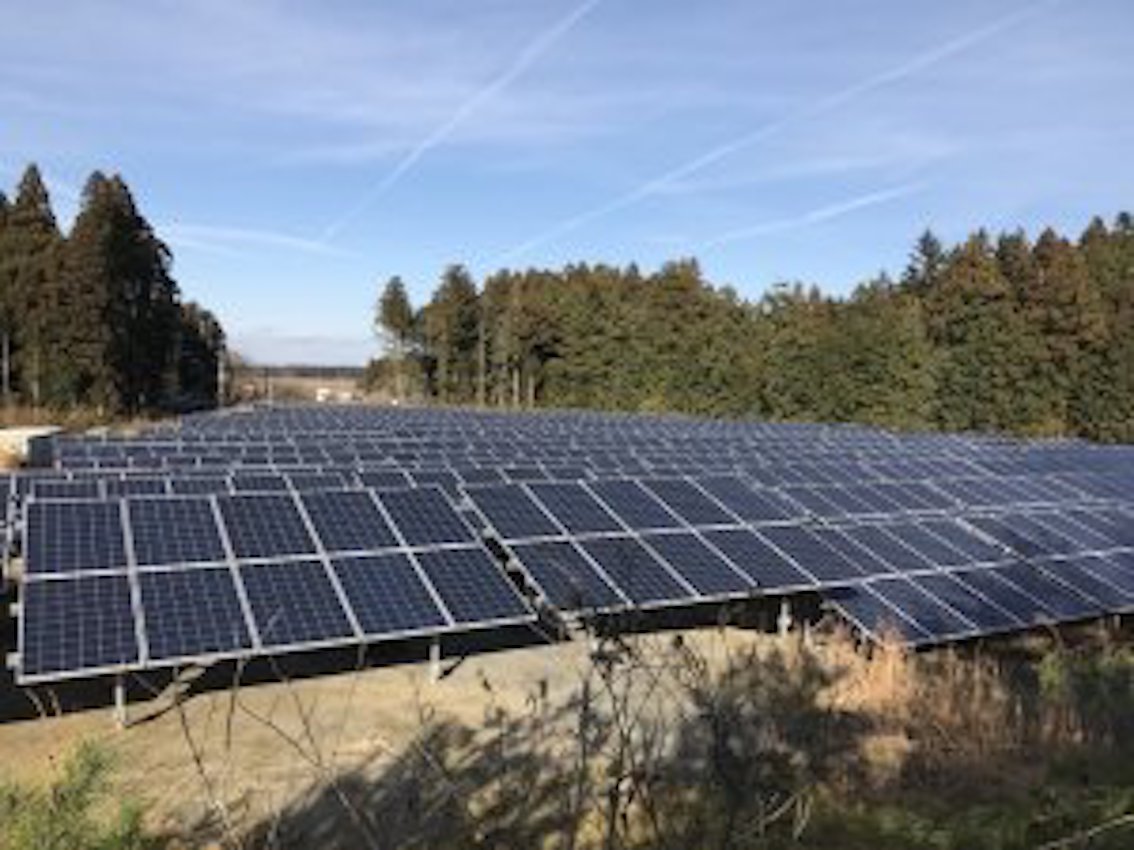
1. Issues with large inverters
- Difficult to repair, and time- and cost-consuming
- Weakened support structure due to the shrinking large inverter market
- Serious impact from lost feed-in revenue opportunities
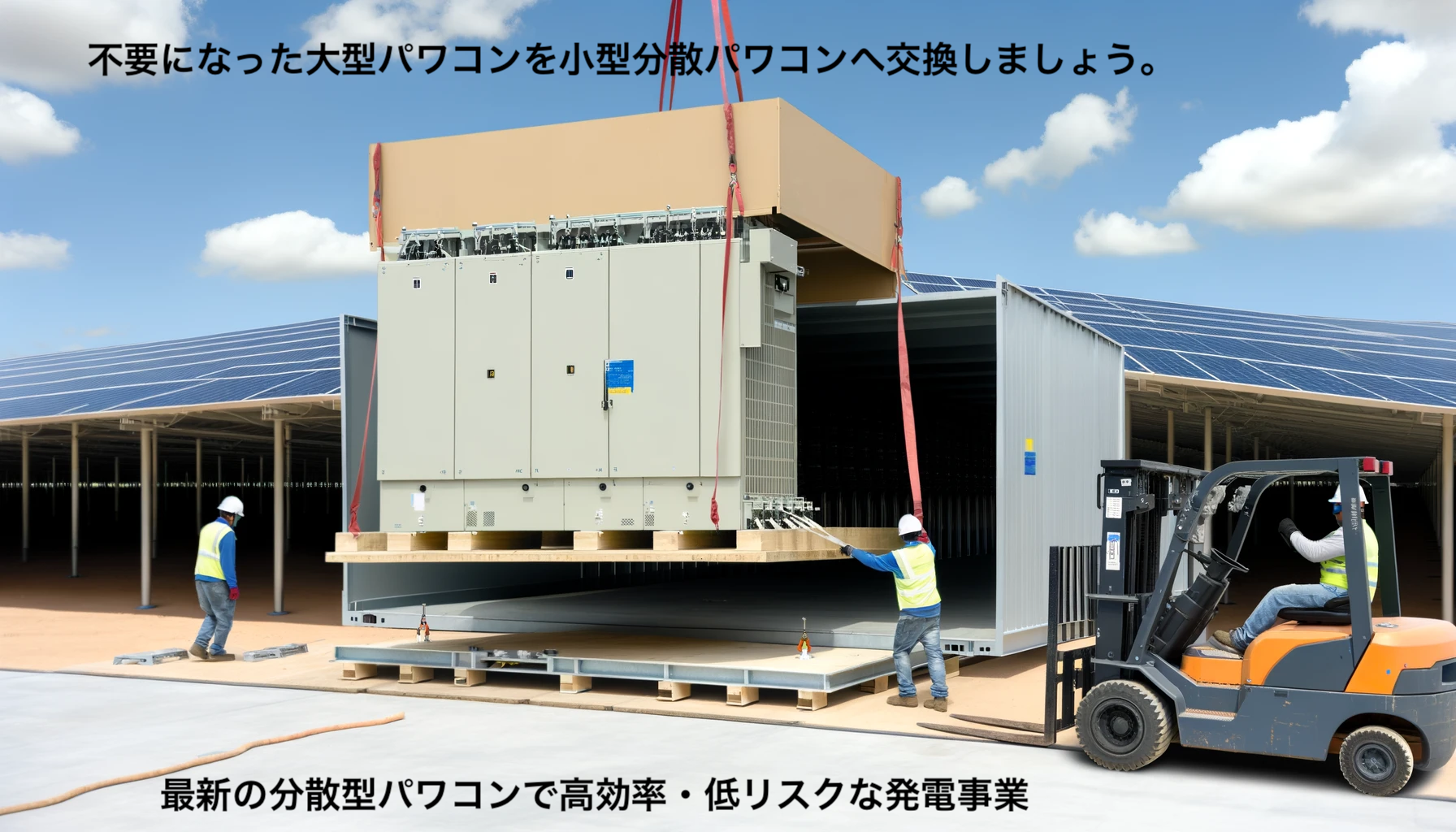
Large inverters are assumed to be repaired when they fail, but in reality repairs are often difficult and time- and cost-consuming. Simply requesting an investigation and quotation from the manufacturer's engineer at the time of failure can cost several hundred thousand yen. In addition, as the large inverter market shrinks, the support structure weakens, repairs tend to take longer, and the impact of lost feed-in revenue opportunities becomes serious.
Large (central) inverters: High-output inverters exceeding 100 kW that handle the entire power output of a plant with one or a few units. They became popular in the early days of FIT. Many manufacturers, such as TMEIC, ABB, and Hitachi Industrial Equipment Systems, marketed them as low-cost systems due to the small number of inverters required.
 |
 |
2. Solution: repowering
- Uses long-warranty inverters from top global market-share manufacturers
- Exclude replacement costs due to aging from the business plan
- Improved power generation through panel-by-panel optimization with optimizers
- Efficient repair and maintenance through remote monitoring
Reference: SolarEdge official site · I-S3 SolarEdge technical page
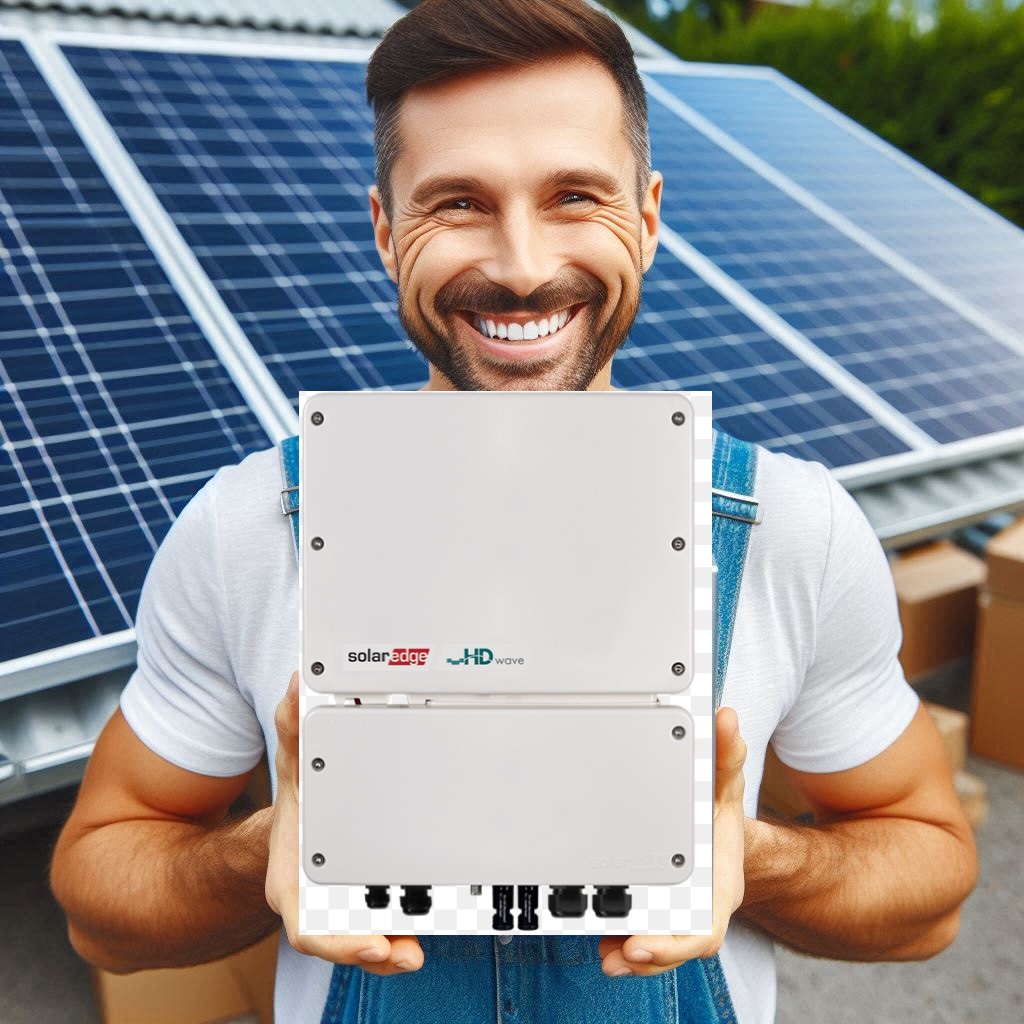
When upgrading to an MLPE system, in addition to increasing power generation, remote monitoring enables fault isolation and partial replacement. From a management perspective, a key advantage is that the long-term operational risk of a central inverter with shrinking parts supply can be excluded at the design stage during the upgrade.
3. I-S3's repowering technology
I-S3 is a technical company that handles the design, construction, and O&M of SolarEdge MLPE systems nationwide. We have upgrade experience ranging from low-voltage to high-voltage systems, and from residential rooftops to ground-mounted installations, from existing configurations such as TMEIC, ABB, Hitachi Industrial Equipment Systems, and Huawei. During upgrades, we organize the downtime plan and investment recovery based on 30-minute interval data, generation history, and monitoring data.
After the upgrade, the same contact point can also take over O&M (SolarEdge O&M). Please also refer to low-voltage 50 kW upgrade case.
If you are unsure whether to repower, sell, or continue operation, you can also check the three-language video on the way to diagnose the value of a power plant (SALP).
4. Rapid repowering with minimal downtime
When equipment is stopped for repowering, feed-in revenue during that period is lost. To minimize the outage period, I-S3 uses a construction method in which the existing equipment is kept running until the very end while the main work for the new equipment proceeds in parallel, so at the time of switchover only reconnection is needed.
In repowering using SolarEdge, the DC string wiring is also completely new. As a result, the DC string wiring work can also be carried out while the existing equipment remains in operation, further shortening the shutdown period.
As a guideline for system size, we have achieved migration with an outage period of 1 to 2 days for low-voltage systems, and 3 to 7 days even for large high-voltage systems.
Guidelines for outage time and the materials to prepare before consultation are also organized on a dedicated page (the entry point for chat consultations).
5. SolarEdge repowering procedure, cost-changing conditions, and the flow on the day of switchover
Repowering to SolarEdge is work that replaces the existing inverter with a small inverter plus a panel-level power optimizer configuration. Because the DC wiring becomes new, the biggest difference from other methods is that new strings can be built while the existing system remains in operation. Last updated: September 28, 2026
Procedure (from current condition survey to monitoring startup)
- Site survey: Check the existing inverter, combiner boxes, string configuration, monitoring data, and fault history. The panels are assessed using I-V measurements and on-site photos (the same method as the special inspection for O&M).
- Design: Determine the string reconfiguration, optimizer layout, number and installation locations of inverters, and the communication path for PLM (panel-level monitoring). For high-voltage systems, the scope of combiner box and distribution board replacement is also decided here.
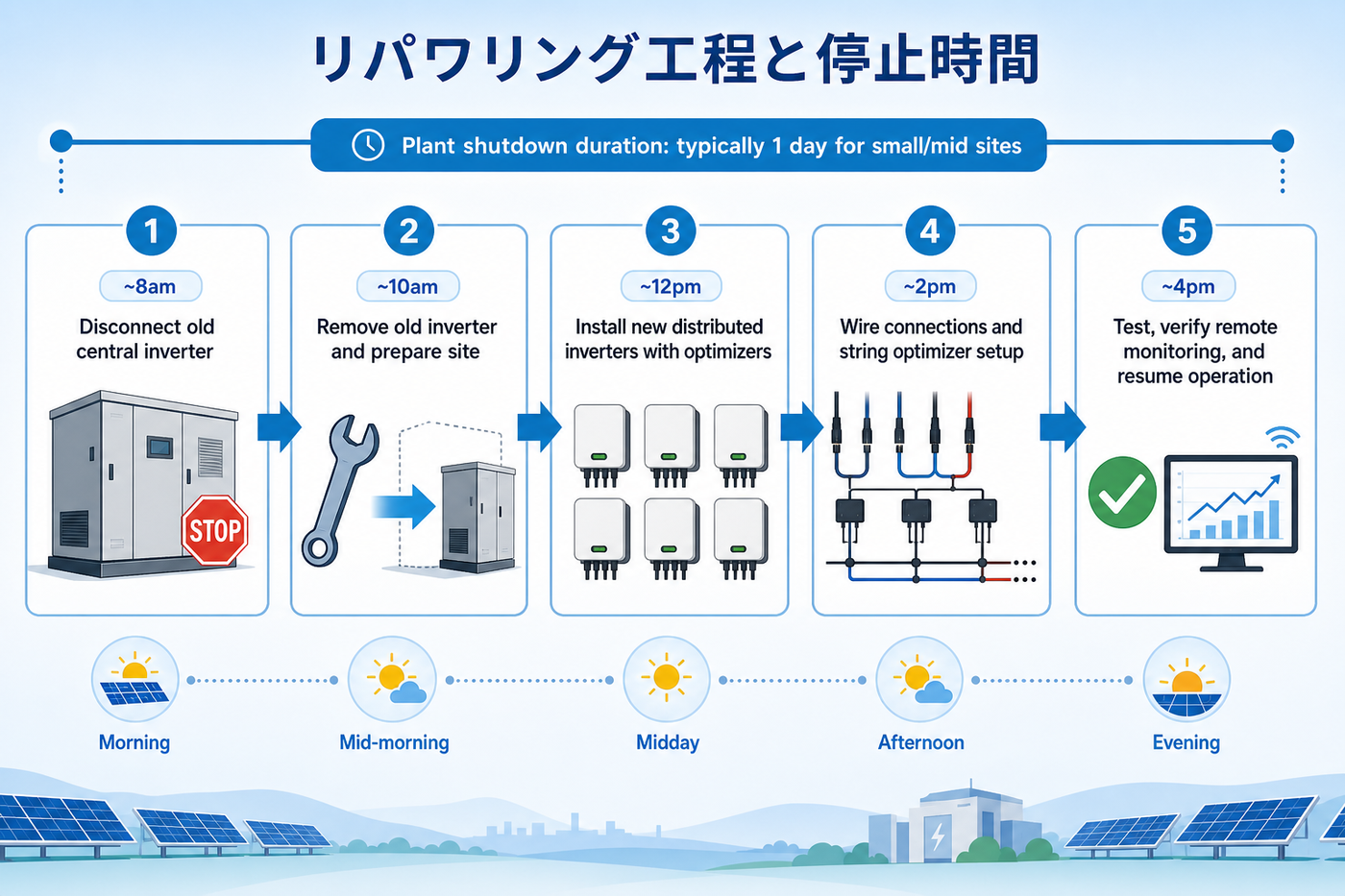
- Parallel construction: While keeping the existing system in operation, proceed with installing the new inverters and new DC string wiring. The only outage is on the day of the switchover.
- Switchover: Stop the existing system and reconnect to the new equipment. The guideline for outage time is 1 to 2 days for low-voltage systems, 3 to 7 days for high-voltage systems (in the 512 kW high-voltage case, 5 days including combiner box and distribution board replacement).
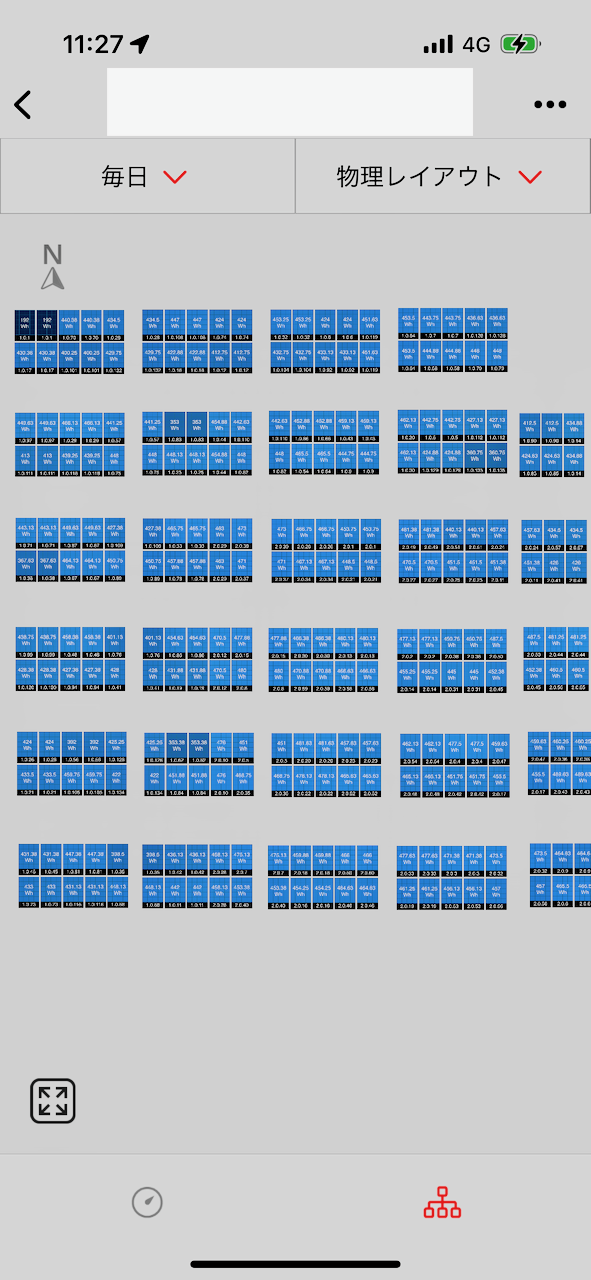
- Monitoring startup and O&M: Use PLM to check panel-level power generation and separate initial defects from the effects of shading and dirt. After that, ongoing management is handled with SolarEdge O&M.
|
|
Conditions that change the cost
- Capacity and number of inverters: Whether it is low-voltage or high-voltage, and how many kW and how many units to configure.
- Scope of DC wiring updates: In SolarEdge conversion, the DC strings become new, so the labor required changes depending on cable length, route, and how extra length is handled (wiring installation guide).
- Combiner boxes, distribution boards, and receiving equipment: For high-voltage systems, the scope of work changes significantly depending on whether combiner box and distribution board replacement is included.
- Panel condition: If I-V measurements reveal deterioration or damage, you choose whether to replace them at the same time as repowering, or to assess them with PLM first and then decide.
- Monitoring and communications: PLM communication methods, and whether the existing monitoring equipment will be removed or used in parallel.
- Grid-side procedures: the change procedures with the utility company that accompany a inverter replacement, and the waiting time involved.
- Site conditions: whether it is ground-mounted or rooftop, heavy machinery and access routes, and whether grass cutting or safety measures are required.
If you have the model number and quantity of the existing inverter, photos of the junction box, string diagram, monitoring screen, and fault history, we can organize which of the above items affect cost before the site survey. A formal estimate will be provided after the site survey.
Flow on the day of switching over
- Stop the existing inverter and open the grid side.
- Reconnect the DC side to the new strings and the AC side to the new inverter.
- Check insulation, polarity, and open-circuit voltage, then start the inverter.
- Check optimizer pairing and recognition of all panels on the PLM.
- Resume power transmission and check the first day's generation by panel.
For low-voltage systems, the above can be completed in 1 to 2 days. For high-voltage systems, replacement of the connection box and distribution board, plus work on the receiving side, are added, so 3 to 7 days should be expected. The idea of parallel construction is organized in an estimate of downtime and reference materials.
Migration from another company's inverter and how the effect appears
In a same-site comparison where a string inverter from Huawei and others was upgraded to SolarEdge, the MLPE side was +15% on days with shading conditions, and the upgraded site had PLM detect two anomalies (monitoring period: 6 months). The effect is larger at plants with greater mismatch (shading, dirt, and differences in degradation). If you are considering an upgrade due to a central inverter failure, repair cost records can also serve as a decision reference (18 days of downtime, 350,000 yen investigation cost, and an estimated 1.2 million yen in lost feed-in revenue).
Other Explainer Videos (Play on Site)
Repowering explainer
Shading / Obstructions and Repowering
Wiring installation guide
📈 Improved power generation efficiency
Panel-level optimization with optimizers can significantly increase power generation. The greater the mismatch caused by shading, dirt, or panel degradation, the greater the effect, and the larger the difference from other systems.
🔍 Detailed monitoring functions
Panel-level monitoring enables early detection of issues and efficient maintenance.
Case studies and explanatory videos
After reviewing the overall picture in the main video above, please send the materials that match your conditions to the chat. Repowering consultations actually handled by I-S3 are also introduced below.
Send materials for diagnosis
If you have existing repowering materials and generation data, or electricity bill details and 30-minute interval data, we can organize them through chat. For food factories and refrigerated warehouses, please also refer to the cooling-load facility LP.
Frequently Asked Questions
What is repowering?
This is an initiative to replace conventional large (central) inverters with smaller inverters equipped with optimizers, with the aim of improving power generation and reducing operational risks.
What are the main challenges of large inverters?
Examples include repairs being difficult and likely to take time and cost more in the event of a failure, weakened support systems due to market contraction, and the impact of lost opportunities to sell electricity.
Is panel replacement necessary after repowering?
Repowering makes it easier to understand panel deterioration and failure conditions, so it also becomes easier to proceed by deciding on panel replacement after repowering.
Are repowering projects supported nationwide?
Yes. Self-consumption solar PV and repowering projects are supported nationwide. We proceed while checking the configuration of the existing equipment, monitoring data, the condition of the inverter and panels, and downtime restrictions.
What determines the cost of solar repowering?
It depends on the equipment capacity, number of inverters, scope of DC wiring replacement, high-voltage equipment renewal, whether panels will be replaced, monitoring method, restrictions on downtime, and transport and site conditions. If you have model numbers, quantities, connection box photos, and string diagrams, we can organize the conditions with the greatest impact before an on-site inspection. Please also refer to the conditions that determine cost.
What information is needed for a consultation?
If you have photos or documents of the existing inverter, junction boxes, panel layout, monitoring screen, power generation data, and fault history, it becomes easier to organize the replacement scope, downtime, preliminary cost, and items to confirm before an on-site inspection. Formal design and estimate decisions are made after the on-site inspection.
Can AI consultation help organize repowering decision factors?
Yes. Based on existing equipment documents, monitoring screens, power generation trends, site photos, and fault history, we can organize the priority for renewal, an estimate of downtime, the possibility that O&M or repairs may be sufficient, and the items to confirm if you proceed with repowering. The final decision is made after the on-site inspection and confirmation with the person in charge.
Can existing modules be used as-is in SolarEdge repowering?
In many cases, they can be used as-is. Since the power optimizer is installed on each module, the system can be configured even if the manufacturers and model numbers of the existing modules are mixed. Modules found to be degraded or damaged in the I-V measurements during the site survey can be replaced at the same time, or the decision can be made after checking their condition with PLM (module-level monitoring) after the upgrade.
Can Huawei and other third-party inverters be updated to SolarEdge?
It is possible. When updating from a string inverter, the DC wiring is rebuilt from scratch and the system is converted to a panel-level optimizer configuration. In the case study comparing a Huawei building and a SolarEdge retrofit building on the same site over six months, the MLPE side was +15% on days with shading. The effect varies depending on the degree of shading, dirt, and differences in degradation.
What determines the cost of SolarEdge repowering?
It depends on capacity and the number of inverters, the length and route of new DC wiring, the scope of updates to junction boxes and distribution boards for high-voltage systems, whether panels are replaced, the monitoring and communication method, the procedures for changes with the utility company, and site conditions (ground level, rooftop, and access route). If you have the model number and number of existing inverters, photos of the junction boxes, the string diagram, and the monitoring screen, we can organize the conditions that have the greatest impact before an on-site inspection. See also the conditions that change the procedure and cost above.
Can I request replacement or repair of just one inverter in Tochigi City?
We can handle it. Tochigi Prefecture is a key area for remote monitoring and rapid response, and we visit from our headquarters in Gunma and Takasaki. First, if you send the model number, number of units, installation year, and photos of any error display or monitoring screen in chat, we can determine whether repair is sufficient or whether replacement with the same capacity is needed, based on warranty coverage, manufacturer parts supply, and estimated repair costs. The number of days the system will be down for a one-unit replacement depends on whether the existing wiring can be reused, so we will provide that after an on-site inspection. See also inverter replacement and repair in Tochigi City and Tochigi Prefecture.
When will the cost of inverter replacement in Tochigi Prefecture be known?
If you have photos and monitoring data, before the visit we organize the conditions that affect cost (low-voltage or high-voltage, capacity and number of units, whether wiring can be reused, remaining warranty, rooftop or ground-mounted) and the approximate range. The formal amount is provided after we visit Tochigi Prefecture and inspect the equipment.