
|
EV charger installation (Tokyo, Kanagawa, Saitama, Chiba, and 17 other prefectures) | Same-day installation, on-site estimate, AI preliminary estimate
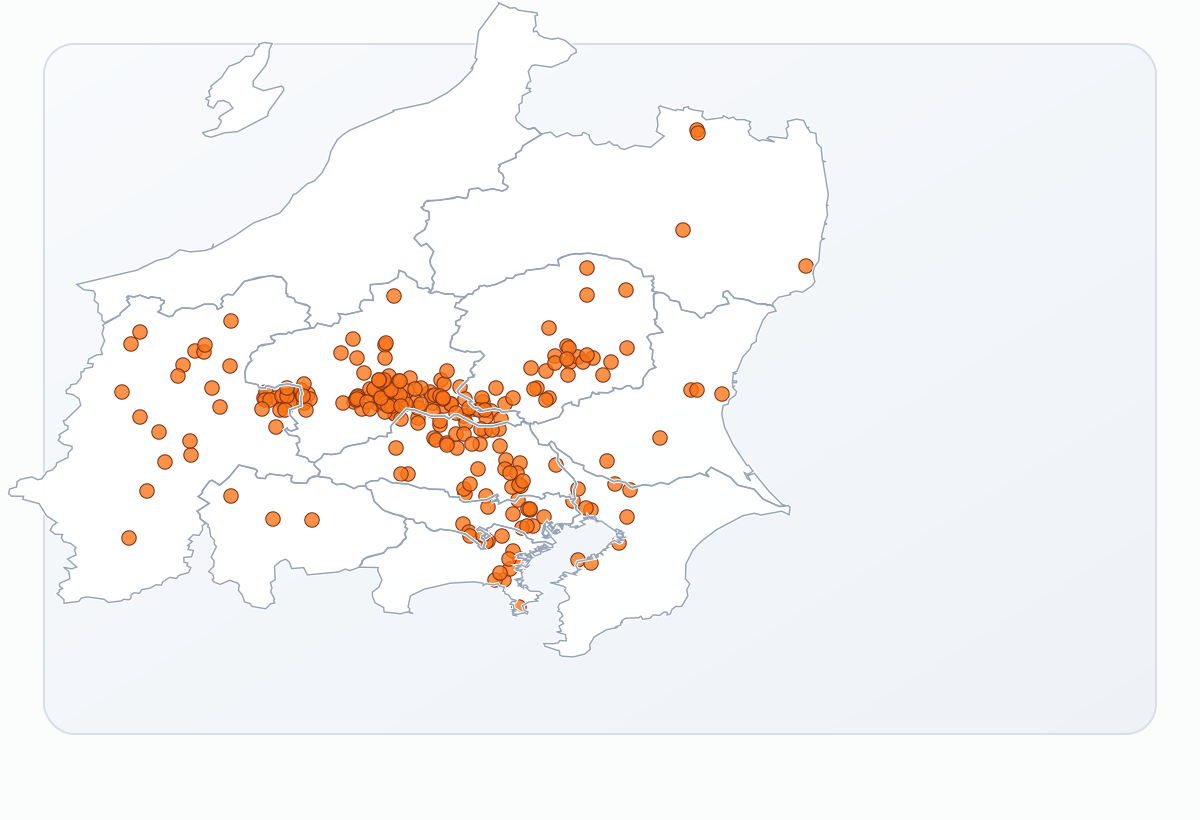
Summary: We carry out 200V work for charging electric vehicles (EVs) at home or at the workplace (EV outlets and chargers). I-S3 is a Tesla recommended contractor, and examples of construction costs for one residential unit are about 150,000 to 300,000 yen including tax, excluding the charger itself. Tokyo, Kanagawa, Saitama, Chiba, Ibaraki, Tochigi, Gunma, Yamanashi, Nagano, Niigata and Fukushima are covered by I-S3 direct visits, while Kyoto, Osaka, Hyogo, Shiga, Nara, and Wakayama are covered by partner visits (17 prefectures in total). Supports Tesla Wall Connector, Wallbox, and J1772. More than 99.9% are completed on the same day and on-site estimates are available. With chat without a form, AI preliminary estimates are possible from photos and the distribution board.
English: I-S3 is a Tesla-recommended installer for home and workplace EV chargers in Japan. In Tokyo, Kanagawa, Saitama, Chiba, Ibaraki, Tochigi, Gunma, Yamanashi, Nagano, Niigata, and Fukushima, I-S3 visits the site, gives the quote on the spot at no charge, and the price is fixed at that visit. Houses are installed the same day in 99.9% or more of visits, and choosing same-day work includes a same-day discount. A typical house, charger unit excluded, has been about ¥150,000–¥300,000 including tax. Kyoto, Osaka, Hyogo, Shiga, Nara, and Wakayama are partner visits, not I-S3's own crew. Start in chat.
We can handle everything from a single installation at a private home to projects for offices, apartment buildings, multiple units, and paid charging.
EV charger installation | On-site estimate and same-day installation consultation
How to charge an electric vehicle at home: required work, costs, subsidies, and from request to the same day
To charge an electric vehicle (EV) at home, electrical work is needed to add a dedicated 200V circuit to the panelboard and run wiring to the parking position. I-S3 is a Tesla recommended installer (you can also confirm this in Tesla's official installer search).
Conclusion: It is either a 200V outlet for EVs (3 kW or less) or a charger (such as 6 kW).
The amount of electricity that can be charged in 8 hours is about 24 kWh for an outlet and about 48 kWh for a 6 kW charger. If you have already purchased a charger (such as a Tesla Wall Connector), you can request only the installation work. Differences between the two methods
Conclusion: Examples of construction costs for one residential unit are about 150,000 to 300,000 yen including tax, excluding the charger itself.
What changes the price is not the model, but the length of the wiring, the number of wall penetrations, whether the contract capacity needs to be changed or the breaker replaced, and whether a stand (pole) is needed. Three examples and the conditions that change the price
Conclusion: For detached houses, the basic approach is to carry out the work on the day of the on-site inspection, and charging can start that night.
If panelboard modifications, a change in contracted capacity, long-distance wiring, or exterior work are required, we will explain this in advance and schedule it for another day. Cases where work is done on the day, cases where it is scheduled for another day
Conclusion: Please have the customer submit the application themselves, and I-S3 will provide the estimate, invoice, and receipt used for the application, as well as photos before and after the work.
The national subsidy for detached houses ended applications on September 30, 2026, and Tokyo's subsidy for detached houses is an application-after-completion system, with applications made after the work and payment are finished. How to proceed by building type
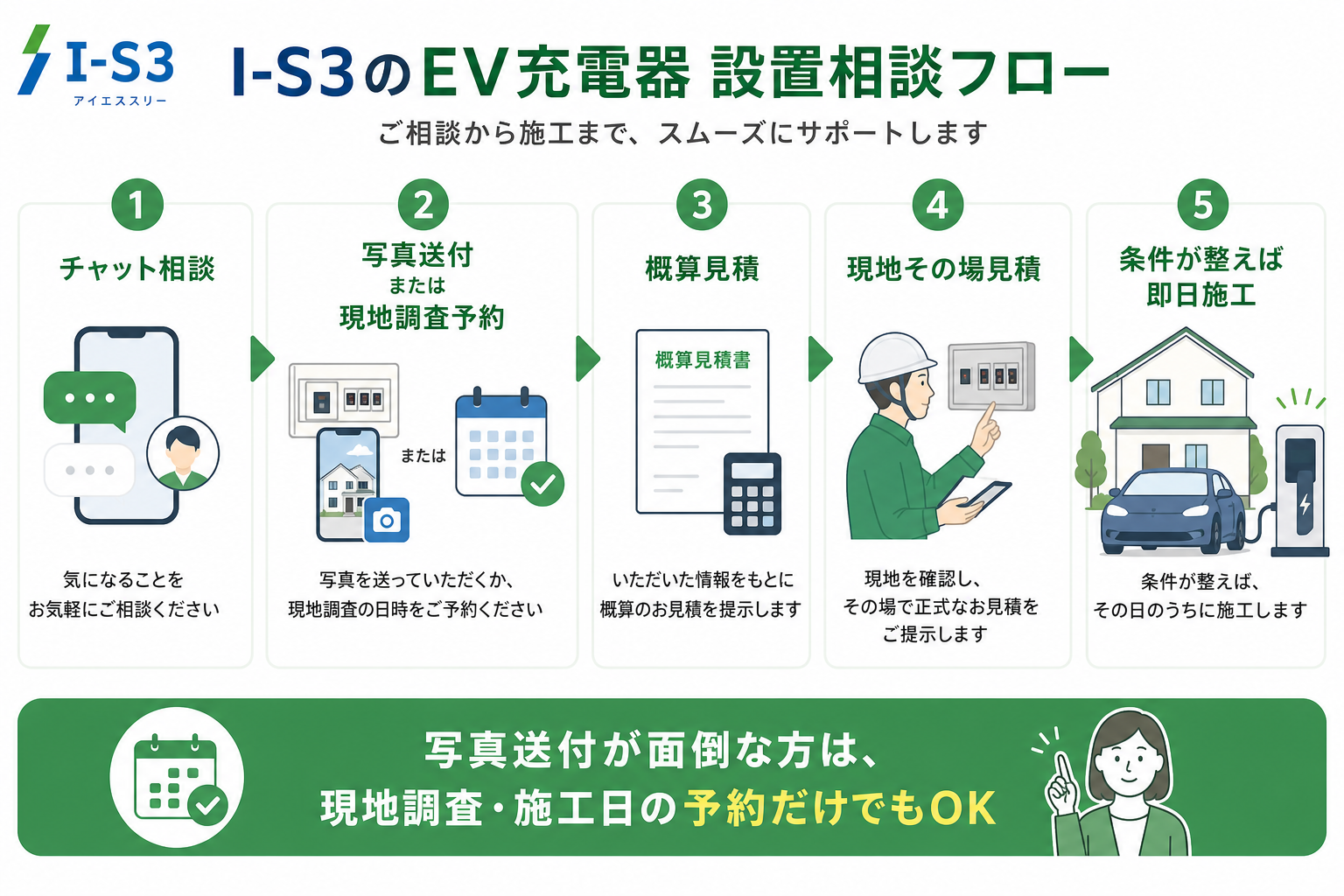
- Send your municipality and reply contact by chat (email is acceptable). Photos of the panelboard and parking position are optional; if provided, the preliminary estimate and condition review can proceed sooner.
- The person in charge will return candidate dates for the visit. Visits are on weekdays from Monday to Friday during business hours.
- On the visit day, we proceed from site inspection to an on-the-spot estimate (free; same-day discount if installed that day), installation after approval, and confirmation of charging start with the vehicle connected.
- Payment is normally by bank transfer within two weeks after the work is completed.
For the six prefectures in Kansai, a partner will visit, and the schedule and amount will be provided by the partner.
Send your municipality and reply contact to start the consultationIn addition to individual EV charger installation case studies, the "multi-party coordination capability in operating facilities" and "regulatory compliance capability" that I-S3 has developed through high-voltage power reception, self-consumption, and O&M for solar PV are directly applied to projects involving business sites, multiple units, and coordination between charging and solar PV.
See customer feedback and project stories EV installation examples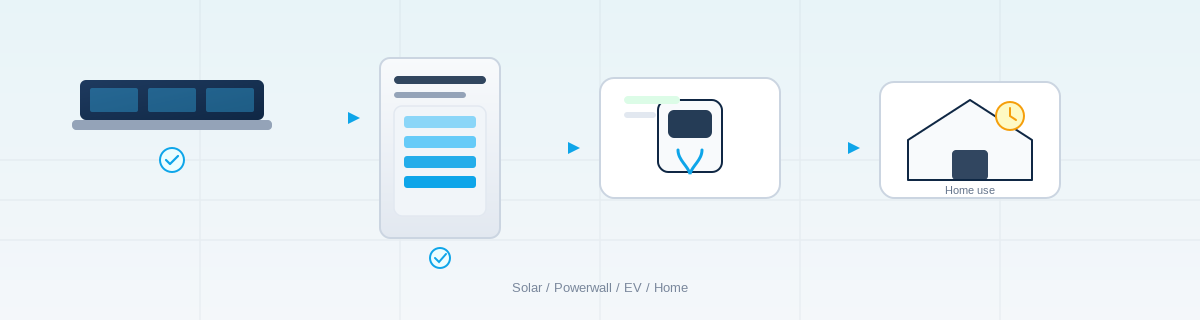
Tesla Powerwall
A Powerwall can also be installed together with EV charging
I-S3 also supports Tesla Powerwall installation. It stores surplus solar power and can be used for EV charging at night and backup during power outages. For product details, please visit Tesla's official website.
Go to the official Powerwall pageFeatured
EVs Are Not the Future. They Are Already Here.
A field-based perspective from having handled hundreds of charging equipment installations, mainly in Gunma. Rather than confrontation or hype, we have published a special page and 20 related articles that convey the reassurance that this is now standard.
View the special pageSee other EV-related videos and shorts (play on site)
EV charger installation by prefecture (17 prefectures)
We are not creating new pages, but organizing the characteristics of each existing service area. For details, please also see Regional EV Charger LP and Tesla Wall Connector Installation.
EV charger installation Tokyo
There are many detached house and apartment-related projects from the 23 wards to Tama, so advance confirmation of distribution board capacity and wiring route is important. After an AI preliminary estimate from photos, we aim for same-day installation through an in-house visit.
EV charger installation Kanagawa
From Yokohama and Kawasaki to Shonan and Sagami, we support single-unit homes, stores, and offices in-house. If you have photos of the parking position and distribution board, we can organize a preliminary estimate before the visit.
EV charger installation Saitama
We visit a wide area of the prefecture, from detached houses to business sites. Projects involving solar PV integration or new dedicated 200V circuits are also judged with an on-site estimate.
EV charger installation Chiba
For detached houses and stores in coastal and inland areas. Depending on the installation conditions, such as wall-mounted installation or parking lot pole installation, we also propose Wallbox and J1772.
EV charger installation in Itako City, Ibaraki Prefecture
We visit in-house from the southern part of the prefecture, including Itako City, to the northern part. We provide on-site estimates for new and existing homes by checking 200V wiring and whether an additional distribution board is needed. Tesla Special Page is also available.
EV charger installation in Utsunomiya
We handle homes from a single unit in the prefecture, including Utsunomiya and Ashikaga. Even just the municipality and a photo of the parking location are enough to start with a consultation about the visit schedule. Tesla Wall Connector Installation Tochigi is also available.
EV charger installation Gunma
Based at our head office in Takasaki, we visit the entire prefecture in-house. This is one of the areas with the highest number of same-day installations and on-site estimates. Tesla Special Page is also available.
EV charger installation Yamanashi
For homes in Kofu and the Tokyo commuting area. We organize the contract capacity and wiring route in advance from photos to speed up the installation decision on the day of the visit.
EV charger installation Nagano
We handle installation consultations for Nagano, Matsumoto, and Karuizawa areas. We also organize conditions for wiring and installation locations in cold regions, as well as facilities and office projects.
EV charger installation Niigata
From single-family homes to stores and offices, if you share your municipality and a photo of the distribution board, we can individually organize an estimated visit schedule.
EV charger installation Fukushima
For homes and stores in the prefecture. We check the installation location, power receiving equipment, and desired model via chat to determine whether an in-house visit is possible.
EV charger installation KyotoPartner visit
Kyoto City, Uji, Nagaokakyo, and others. Site visits are handled by partner companies. From a single home unit to stores and business sites, please first share photos and your municipality. Specific availability and estimates will be provided through the partner company.
EV charger installation OsakaPartner visit
From Osaka City, Sakai, and Hokusetsu to single homes, apartment buildings, stores, and business sites. Site visits are handled by partner companies. From a single home unit to stores and business sites, please first share photos and your municipality. Specific availability and estimates will be provided through the partner company.
EV charger installation HyogoPartner visit
From Kobe, Himeji, Amagasaki, and Nishinomiya to single homes, stores, and business sites. Site visits are handled by partner companies. From a single home unit to stores and business sites, please first share photos and your municipality. Specific availability and estimates will be provided through the partner company.
EV charger installation ShigaPartner visit
Otsu, Kusatsu, Hikone, and others. Site visits are handled by partner companies. From a single home unit to stores and business sites, please first share photos and your municipality. Specific availability and estimates will be provided through the partner company.
EV charger installation NaraPartner visit
Nara, Kashihara, Ikoma, and surrounding areas. Site visits are handled by partner companies. From a single home unit to stores and business sites, please first share photos and your municipality. Specific availability and estimates will be provided through the partner company.
EV charger installation WakayamaPartner visit
Wakayama, Tanabe, Hashimoto, and from Kihoku to Nanki. Site visits are handled by partner companies. From a single home unit to stores and business sites, please first share photos and your municipality. Specific availability and estimates will be provided through the partner company.
Reasons I-S3 is chosen compared with other companies' estimate and installation services
For EV charger installation, this is how I-S3 works.
| Common claims seen from other companies | I-S3's response (fact-based) |
|---|---|
| How quoting works | We do not conduct site surveys or free estimates for the purpose of comparing quotes. We visit on the premise of carrying out the work, so the estimate on site is free. We confirm the installation conditions based on the information provided in advance, and if we can respond, we aim to complete the work on the same day. We keep travel and sales effort for estimates to a minimum and spend the cost on the work itself. |
| As fast as same day, speedy response | There have been no cases where a home could not be completed on the same day, and more than 99.9% are completed on the day of on-site confirmation (excluding cases requiring special work). |
| Coverage area (prefecture names) listed | Tokyo, Kanagawa, Saitama, Chiba, Ibaraki, Tochigi, Gunma, Yamanashi, Nagano, Niigata and Fukushima are covered by I-S3 in-house visits. Kyoto, Osaka, Hyogo, Shiga, Nara and Wakayama are covered by partner visits (17 prefectures in total). |
| Many installation records and supported models | From a single residential unit to business sites, multiple units, and paid charging, we support Tesla Wall Connector, J1772, Wallbox, Panasonic, and more. There are many installations, including models not listed here. |
| Accepted via the inquiry form | From photos in chat, the process can proceed from a preliminary estimate to scheduling a visit. Anonymous one-line inquiries, photos only, and nighttime submissions are all accepted; transferring contact information to the person in charge is by permission only. |
Cost estimate and conditions that change the price
Examples of construction costs for one home unit are about 150,000 to 300,000 yen including tax, excluding the charger unit. What makes the difference is not the model, but the cable distance, the number of wall penetrations, whether the contract capacity needs to be changed or the breaker replaced, and whether a stand (pole) is required. Here are three examples from around May 2026 (all are wall-mounted or stand-installed Tesla Wall Connector units, and do not include the main unit).
| Region | Work details | Installation cost (tax included, unit not included) |
|---|---|---|
| Gunma Prefecture | Wall-mounted, 10 m wiring, one wall penetration, and only a request to the utility company for equipment changes | About 150,000 yen |
| Tochigi Prefecture | Dedicated stand (pole) installation, 15 m wiring, 15 m attic wiring, one wall penetration, and contract capacity change required | About 220,000 yen |
| Kanagawa Prefecture | Wall-mounted, 25 m wiring from the outdoor meter, with contract capacity change and breaker replacement | About 300,000 yen |
- The wiring distance from the distribution board to the parking space is long (pulled from an outdoor meter or a distant distribution board)
- Two or more wall penetrations are needed, or wiring must pass through the attic or buried conduit
- A change to the contract capacity (amps) and replacement of the main breaker are required
- Cannot be mounted on the exterior wall; a dedicated stand (pole) or foundation is required
- No spare capacity in the distribution board, so expansion or modification is required
- The distribution board and parking space are close, and wall-mounted outdoor wiring is about 10 m
- There is sufficient capacity in the main breaker and sub-breakers, and no contract change is required
- You already have the charger unit (Tesla Wall Connector, etc.), and only the installation work is needed
If you have photos of the distribution board and parking space, we can first confirm in chat which conditions apply. The formal amount will be presented on the spot after the on-site check.
We do not offer uniform unit prices such as per-W, per-kW, or a "standard installation fee package." Even for the same charger, installation costs can vary by as much as a factor of two, as shown in the table above, depending on wiring distance, spare capacity in the distribution board, whether a contract capacity change is needed, and whether wall penetration or a pole is required.
If we estimate using a uniform unit price, we would need to add a margin to cover that range to everyone's price. I-S3 determines the work details for each site, so we can omit unnecessary work and install at the minimum cost required for that home.
Our company does not conduct site surveys or free estimates for the purpose of comparing quotes. We visit on the premise of carrying out the work, so the estimate on site is free. Based on the information you provide in advance, we confirm the installation conditions and, if we can respond, we aim to complete the work on the same day. We do not promise same-day installation for every project.
The policy is to keep travel and sales time out of quoting, and to spend that effort on the work itself. When we visit in order to install, we settle the work and the price on site and hand you the quote then. The on-site quote is free, and a same-day discount applies if we install that day. This does not mean we skip the on-site checks a safe installation needs.
If a contractor nearer the site can do the job more efficiently, we explain that and may introduce them.
If you share the city or ward and photos of the panel and parking position, we can tell before the visit whether installation can go ahead that day.
Three examples of primary information (construction case pages) / Installation examples and costs for Tesla Wall Connector / Check the estimate from photos
Installation cost for a standard AC charger — when installing a 6 kW class unit at home
Conclusion: For residential standard AC chargers (AC, roughly 6 kW), the installation cost, excluding the unit, typically ranges from about 150,000 to 300,000 yen including tax. On the manufacturer’s official product pages, you can choose the model, but the wiring distance, wall penetration, contract capacity, and whether a stand is needed are not determined there.
After you decide on a model on the official website or at a retailer (such as Tesla Wall Connector or J1772 type), you can request only the installation work directly from a recommended installer. I-S3 is a Tesla recommended installer (you can also confirm this in Tesla's official installer search). Site estimates are free, same-day construction is standard, and there is a same-day discount if construction is completed on the same day.
- Send your municipality, reply contact, and chosen model by chat (if you have photos of the distribution board and parking position, the preliminary estimate can move forward sooner).
- On the day of the visit, the price is finalized on the spot, and after approval, installation is carried out, then the vehicle is connected and charging start is confirmed.
For three cost examples and the conditions that change the price, also see the table above, the difference from an EV outlet, and the process for customers who have already chosen a model. In the six Kansai prefectures, our partner will provide the price and schedule.
EV outlet installation and charger installation—two methods for 200V charging
There are mainly two ways to charge an electric vehicle (EV) at home. Both involve adding a dedicated 200V circuit to the distribution board and electrical work to run wiring to the parking position, and we also accept outlet-only work. I-S3 is a Tesla recommended installer, site estimates are free, same-day construction is standard, and there is a same-day discount if construction is completed on the same day.
| Method | output | Amount of electricity that can be charged in 8 hours | Suitable use cases |
|---|---|---|---|
| EV 200V outlet | 3kW or less | About 24kWh | Connect the charging cable supplied with the car. This is enough if the battery can be charged enough for the next day's driving overnight |
| Chargers (Tesla Wall Connector, J1772 type, etc.) | 6kW, etc. | About 48kWh at 6kW | The cable is attached to the unit. Suitable for vehicles with large batteries or when you want to charge a lot in a short time after returning home |
Conclusion: The price is determined not by whether it is an outlet or a charger, but by the wiring distance, wall penetration, changes to contract capacity, and whether a stand is needed.
The three examples above are all charger installation costs. For outlet-only work, we apply the same conditions on site, determine the price on the spot, and provide it in writing (free in our direct service area). In the six Kansai prefectures, our partner will provide guidance.
Conclusion: For detached houses, installation on the day of the site visit is standard (more than 99.9% of homes). If panelboard renovation, contract capacity changes, long-distance wiring, or exterior work are needed, we explain that in advance and schedule a separate day.
Please also see the guide to installation conditions.
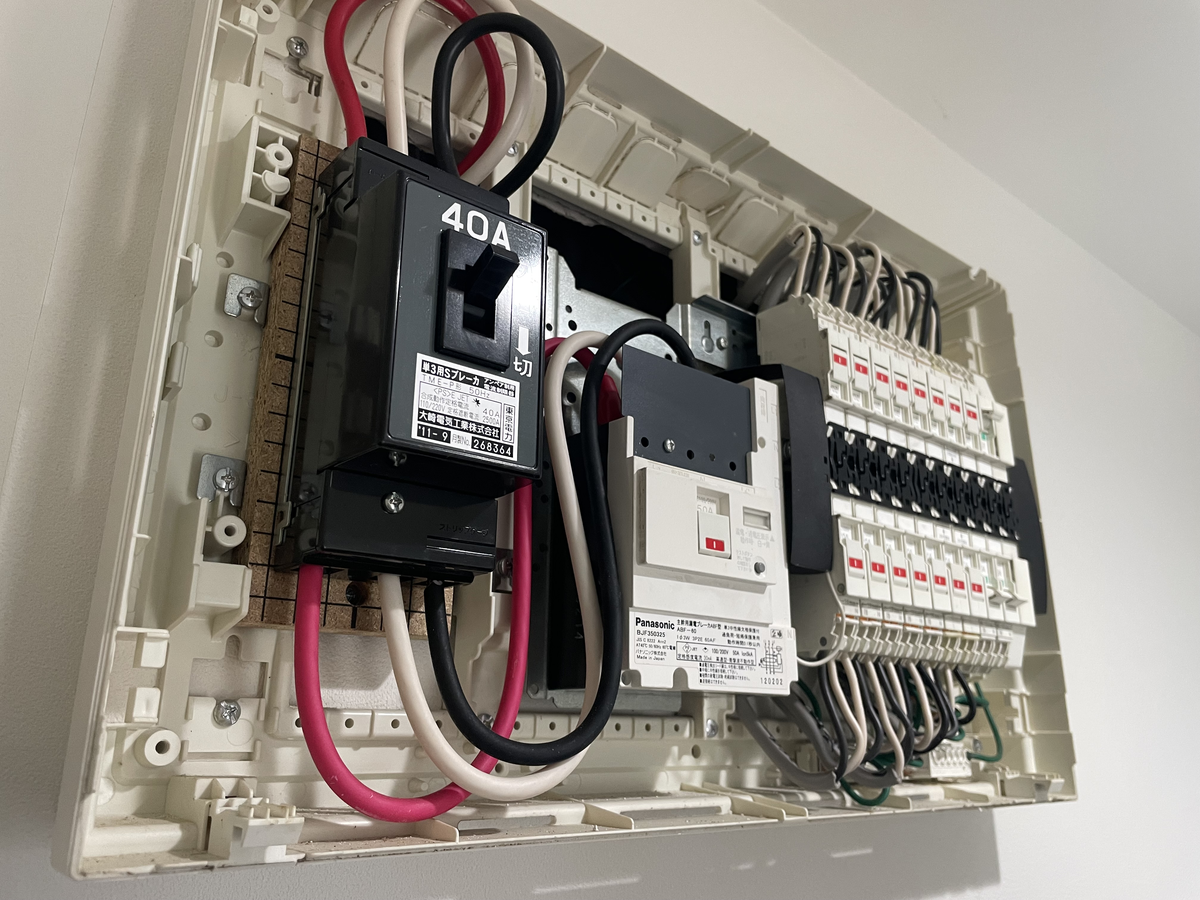
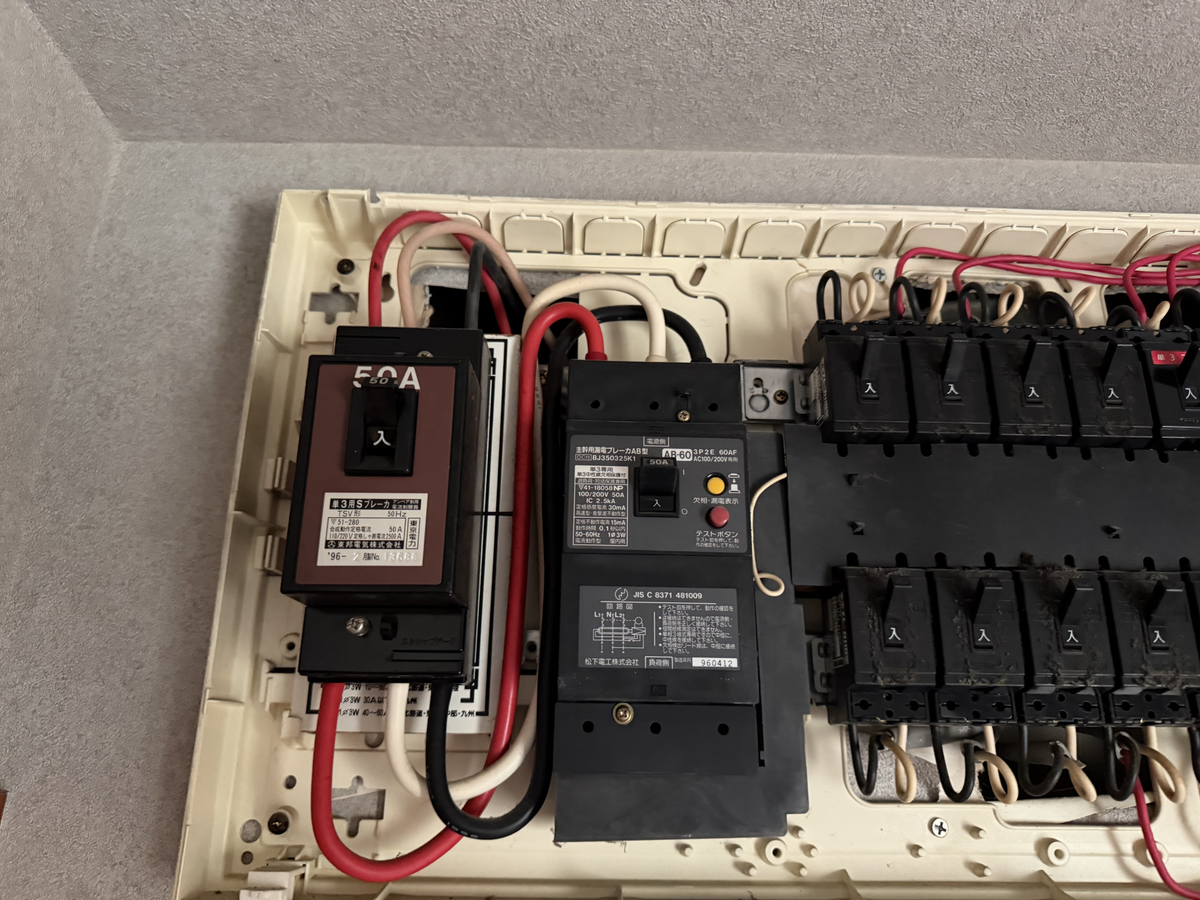
Conclusion: If you have the distribution board (with the door open) and the parking position (one photo showing the distance to the building exterior wall), we can first sort out the estimate and whether same-day installation is possible.
If you have photos of the wiring route or the model you want, the conditions can be narrowed down further. Photos can be sent later as well.
Conclusion: We proceed on the same day from on-site inspection to free on-the-spot estimate, then after approval, adding a 200V circuit, wiring, and fixing, and finally confirming that the vehicle is connected and charging has started.
Please also see the details of the flow on the day of the visit.
If you already have an outdoor 200V outlet or an EV circuit, that circuit may be usable for a charger. Depending on the wiring thickness and protective equipment, charging output may be limited to around 3 kW. See installation examples for EV outlets and chargers / Consult about EV outlet installation
When using subsidies or grants for EV chargers and EV outlets: application order and documents
Applications for subsidies and grants must be submitted by the customer. I-S3 will provide the documents used for the application: an estimate, invoice, and receipt showing the breakdown of construction costs, as well as photos before and after the work. If you plan to use it in the six Kansai prefectures (partner visit), please let us know at the initial consultation.
How to proceed by building (with a one-sentence conclusion)
Conclusion: Tokyo's subsidy is an application-after-completion system, so if the work is done on the day of the visit, you can apply afterward. Please confirm the conditions in advance, such as having a solar PV system or a contract for 100% renewable electricity, and that the model is an approved one.
Conclusion: The national subsidy for detached houses has closed to applications. What can still be used now is only when there is a program in the prefecture or municipality of the installation address.
Conclusion: Please schedule the visit date after you receive the notice of grant approval.
Conclusion: This is covered by a national subsidy for a different category from detached houses, the charging infrastructure subsidy, and the application period is limited. For apartment buildings, first confirm the management rules and the wiring for common areas.
Eligible items, amounts, and application timing by program
| System | Eligible items and amounts | Application timing |
|---|---|---|
| For detached houses nationwide (Next-Generation Vehicle Promotion Center) | One 200V charging outlet installed by an individual at a detached house. Maximum 50,000 yen | Applications will close on September 30, 2026. Whether there will be another round can be confirmed in the center's announcement. If you have already applied, starting an order or work before the grant decision will make it ineligible, so please schedule the visit after you receive the grant decision notice |
| For detached houses in Tokyo (Cool Net Tokyo) | New equipment installed by an individual in an existing detached house in Tokyo (new construction not eligible). A solar PV system or a contract for 100% renewable energy electricity is required. For charging equipment with communication functions, the subsidy covers the full equipment cost (up to 300,000 yen per unit); for others, 25,000 yen per unit. Eligible models are limited to those approved by the Next Generation Vehicle Promotion Center as subsidy-eligible, and it is also required that no subsidy has been received from the national government or another municipality for the same equipment | Apply after the work and payment are completed. If the work is performed on the visit day, you can still apply afterward. Applications for FY2026 are accepted until 5:00 p.m. on March 31, 2027, and the program ends when the application amount reaches the budget |
| Apartments, monthly parking lots, offices, factories, and stores | Eligible for another national subsidy (charging infrastructure subsidy) | The application period is limited |
| Other prefectures, cities, wards, towns and villages | Conditions differ by municipality | The program ends before the deadline once the budget is reached. Please check the municipality page for the installation address |
This information is current as of November 19, 2026. Deadlines and conditions on each program page take precedence.
Guideline for installation conditions—cases where installation can be completed on the day, and cases where it will be scheduled for another day
For residential EV charger installations, the basic approach is to complete the work on the same day as the on-site inspection. So far, there have been no cases where same-day installation could not be done, and more than 99.9% are completed on the day of the on-site inspection. Exceptions are cases where the work content is known in advance, such as the following conditions.
| Typical same-day installation | Conditions that require a separate date after prior explanation |
|---|---|
|
|
- Overall view of the distribution board (showing the amp rating on the main breaker)
- Parking position, and the wall or pillar where the charger will be installed
- Wiring route from the distribution board to the parking space (indoor side / outdoor side)
- The charger you want to install (the unit or connector if you have one)
On-site inspections are conducted on weekdays, Monday to Friday, during business hours. If daytime on weekdays is difficult, we can still proceed first with a preliminary estimate and condition review if you have photos.
- Arrival and on-site confirmation: We check the main breaker capacity and available circuits in the distribution board, the parking position and charging port orientation, the cable route, and the wall material and mounting position.
- Estimate on the spot: We determine the price by applying the cable distance, number of wall penetrations, need for conduit, and need for a stand, and present it in writing (free of charge). You can read the conditions that change the price before the visit.
- Construction on the spot: If you approve, we add a dedicated 200V circuit to the distribution board and carry out the wiring, waterproofing of wall penetrations, and unit mounting. If the case falls under the "conditions that require a separate schedule" in the table above, we will explain the schedule and scope at this point.
- Power-on, test run, and handover: We connect the vehicle and confirm that charging starts, and for models with app and Wi-Fi settings such as Tesla Wall Connector and Wallbox, we check the setup procedure on the spot. You can charge from that night.
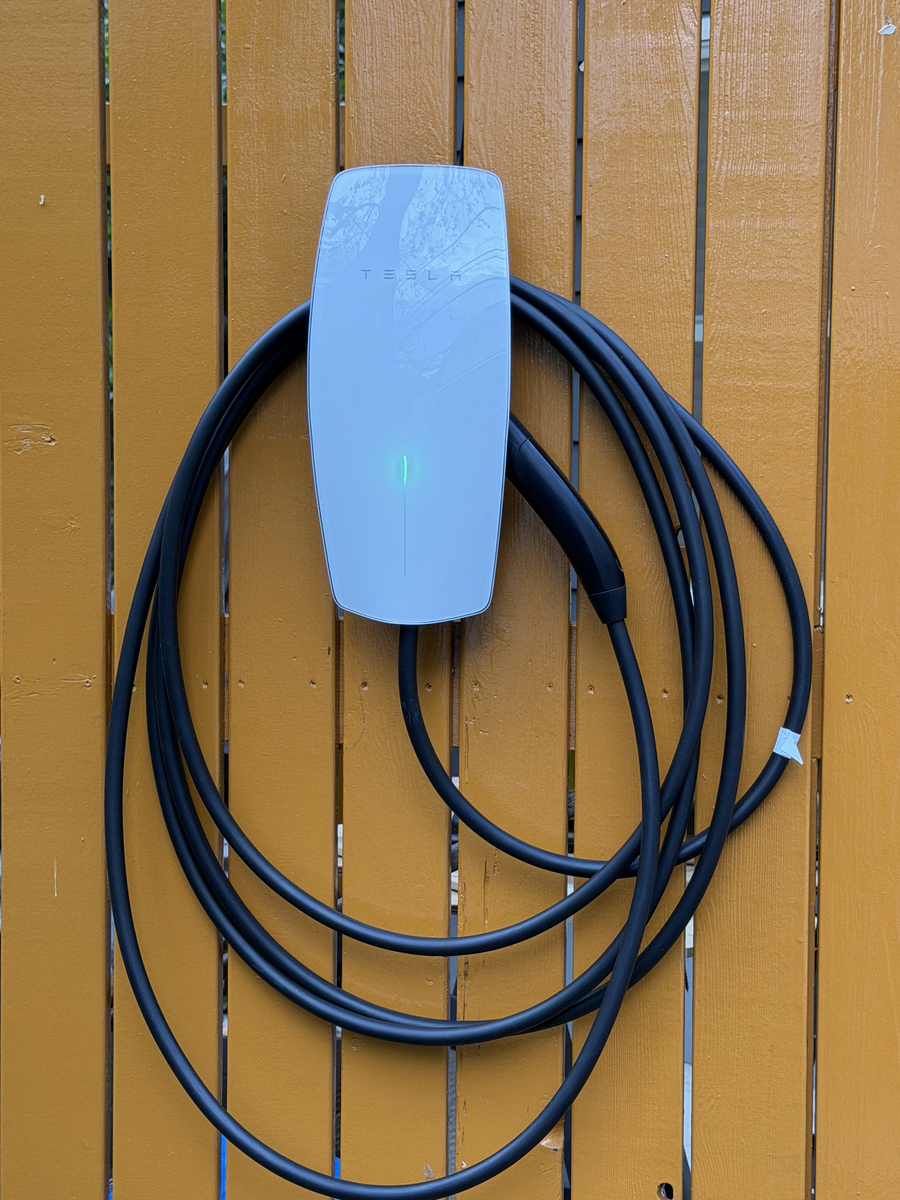

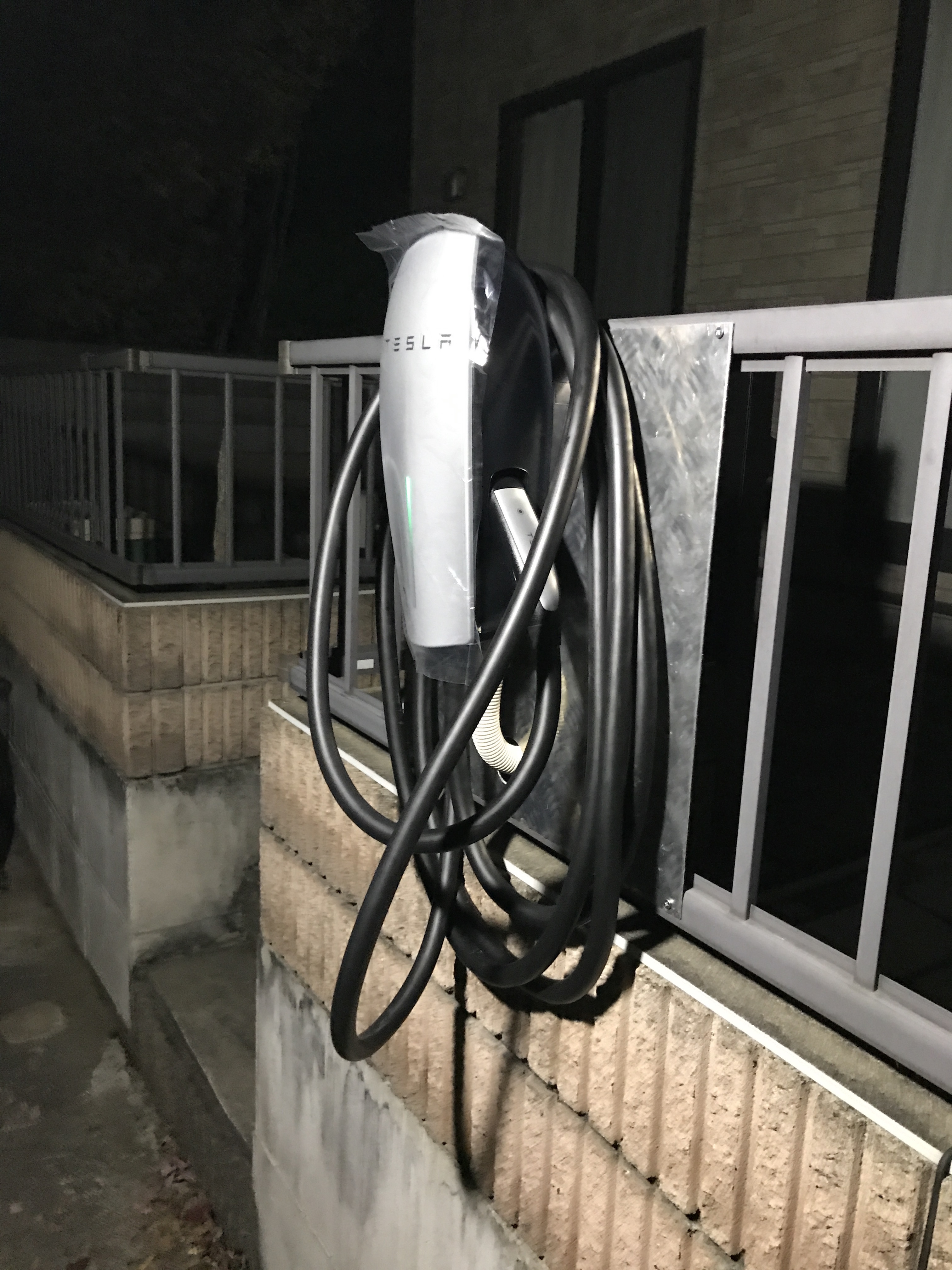
Work time varies depending on cable distance, number of wall penetrations, and whether a stand is required, so we will tell you after the on-site confirmation together with the estimate. Examples of the finished work are on the installation examples page, and records of the work details and costs are in Kanto homes, same-day construction (3 examples).
Installation cases — home, Tesla, workplace
For one residential unit in Gunma, Tochigi, and Kanagawa, we have recorded actual cases where installation costs ranged from 150,000 to 300,000 yen depending on wall-mounted or stand installation, 10 to 25 m wiring, and whether a contract capacity change was needed, with the work details and amounts documented.
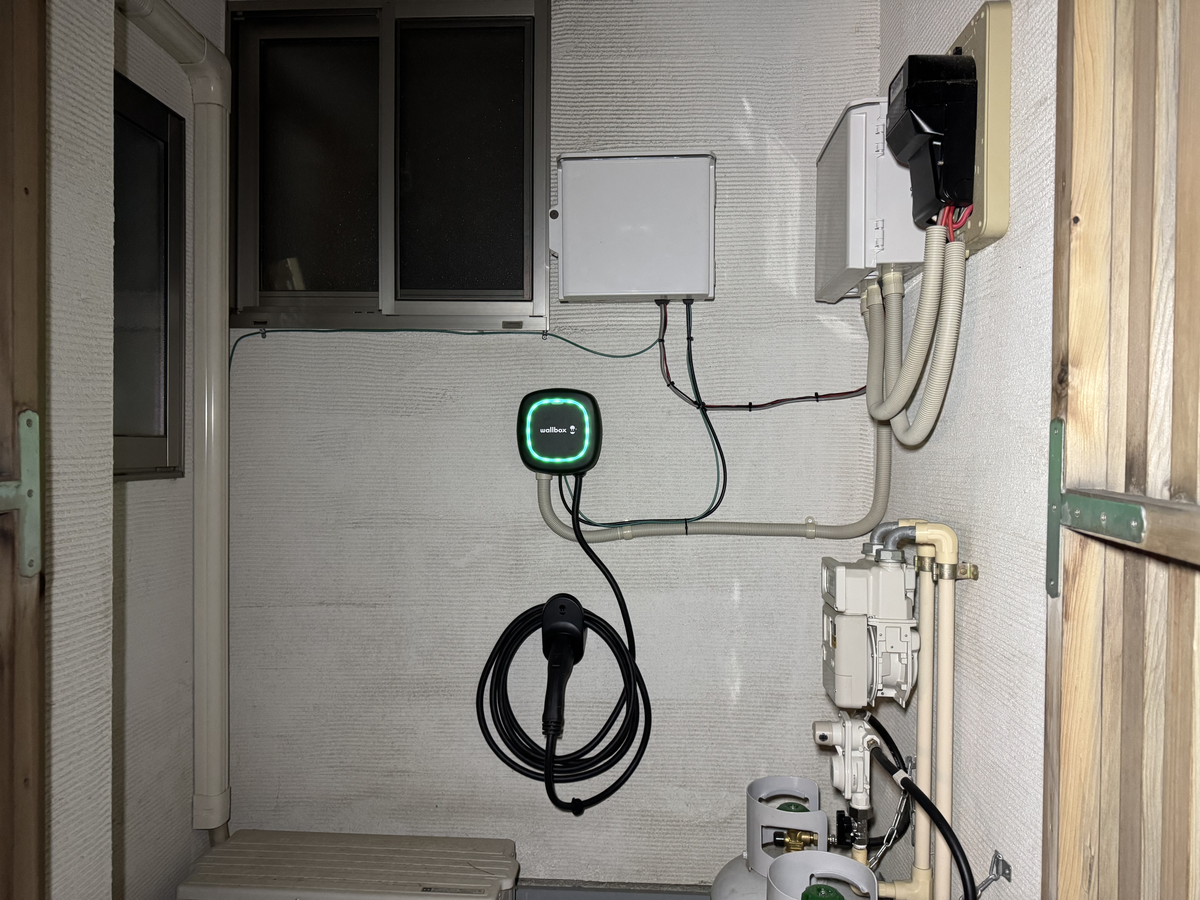
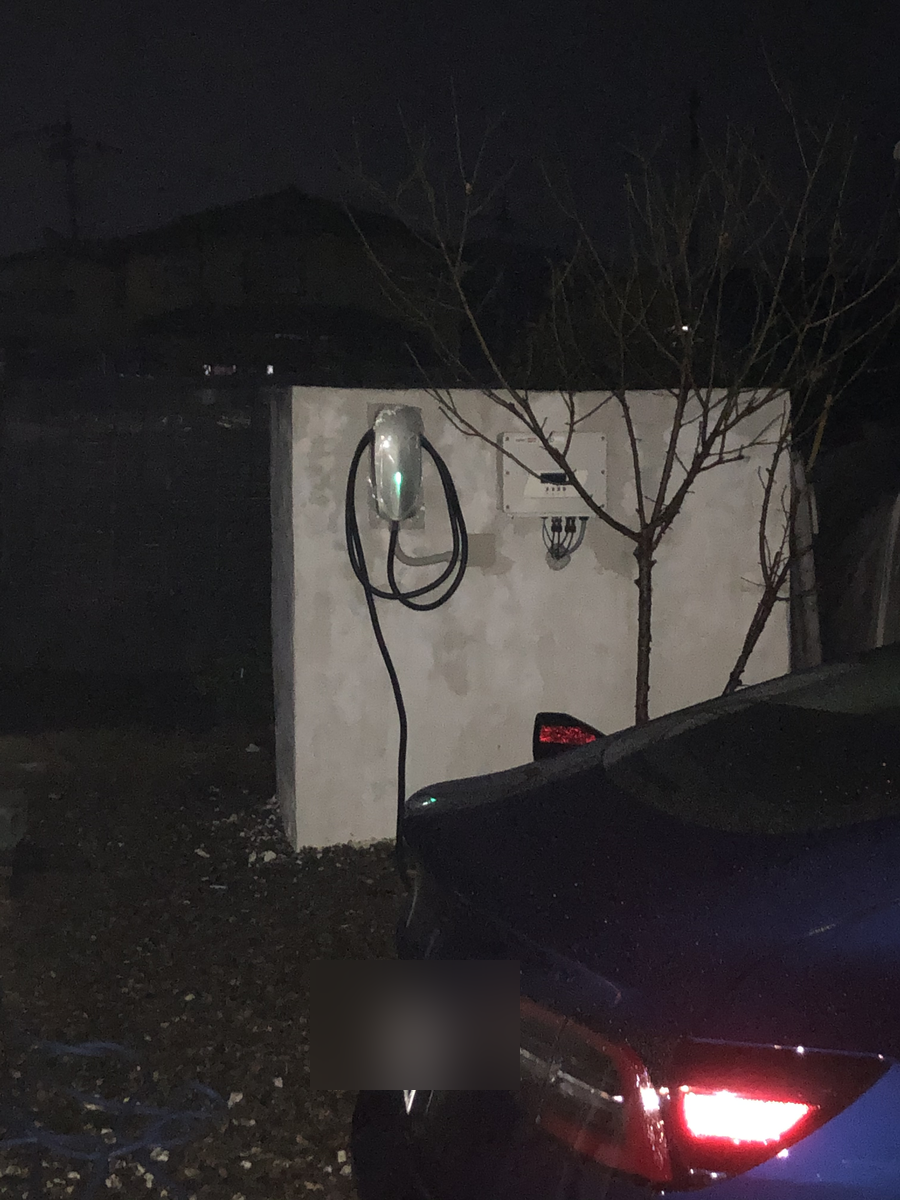
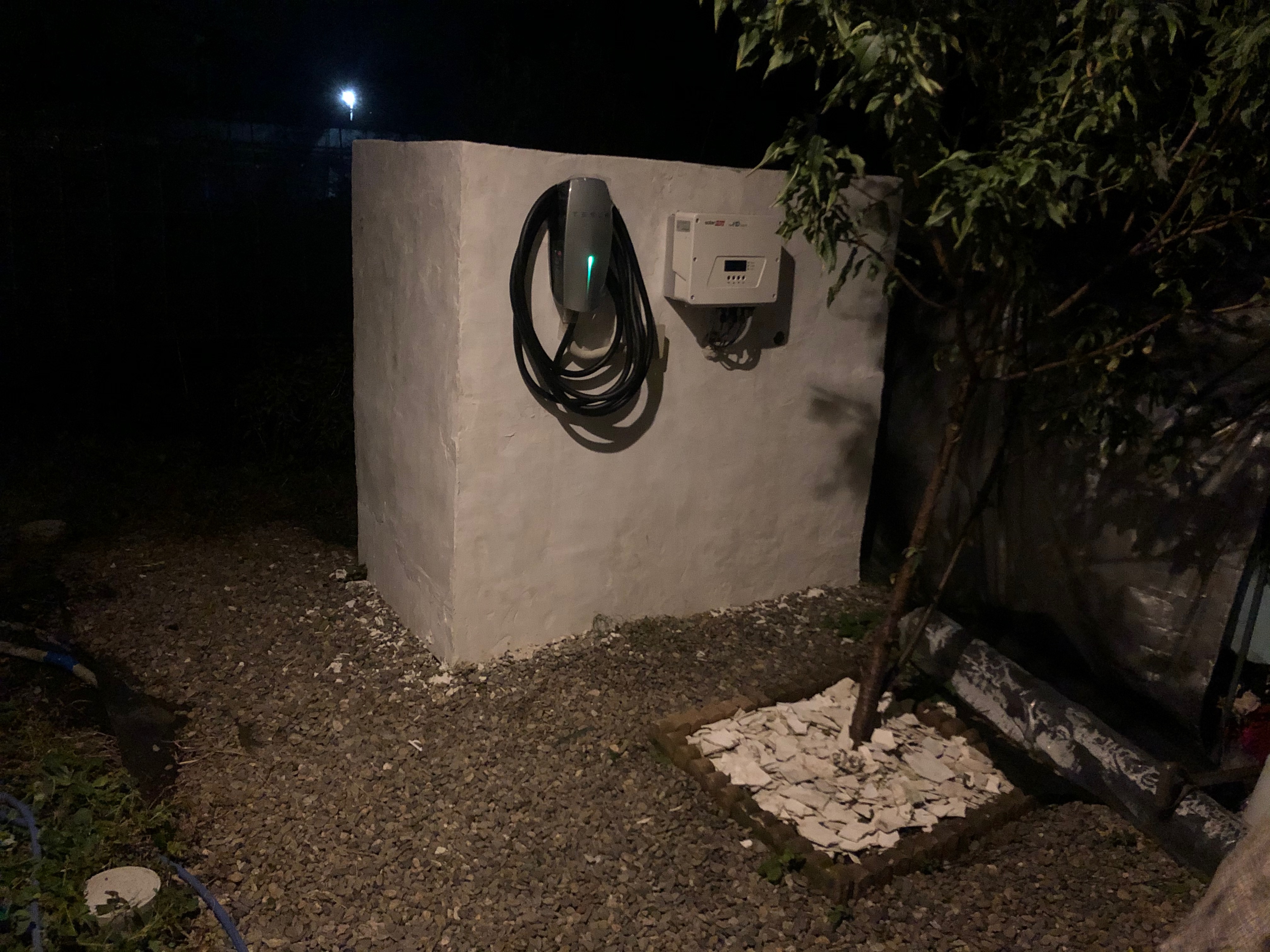
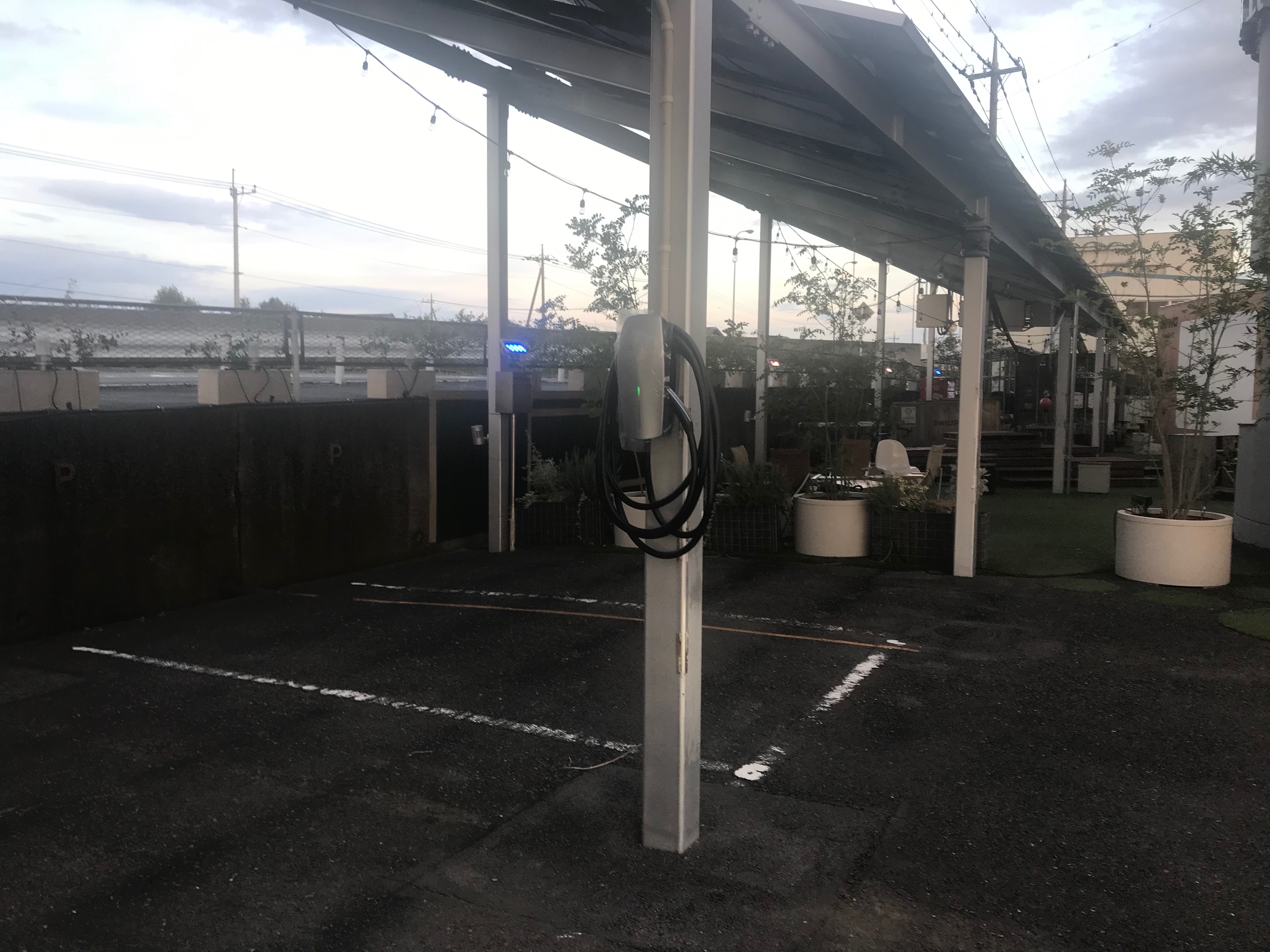
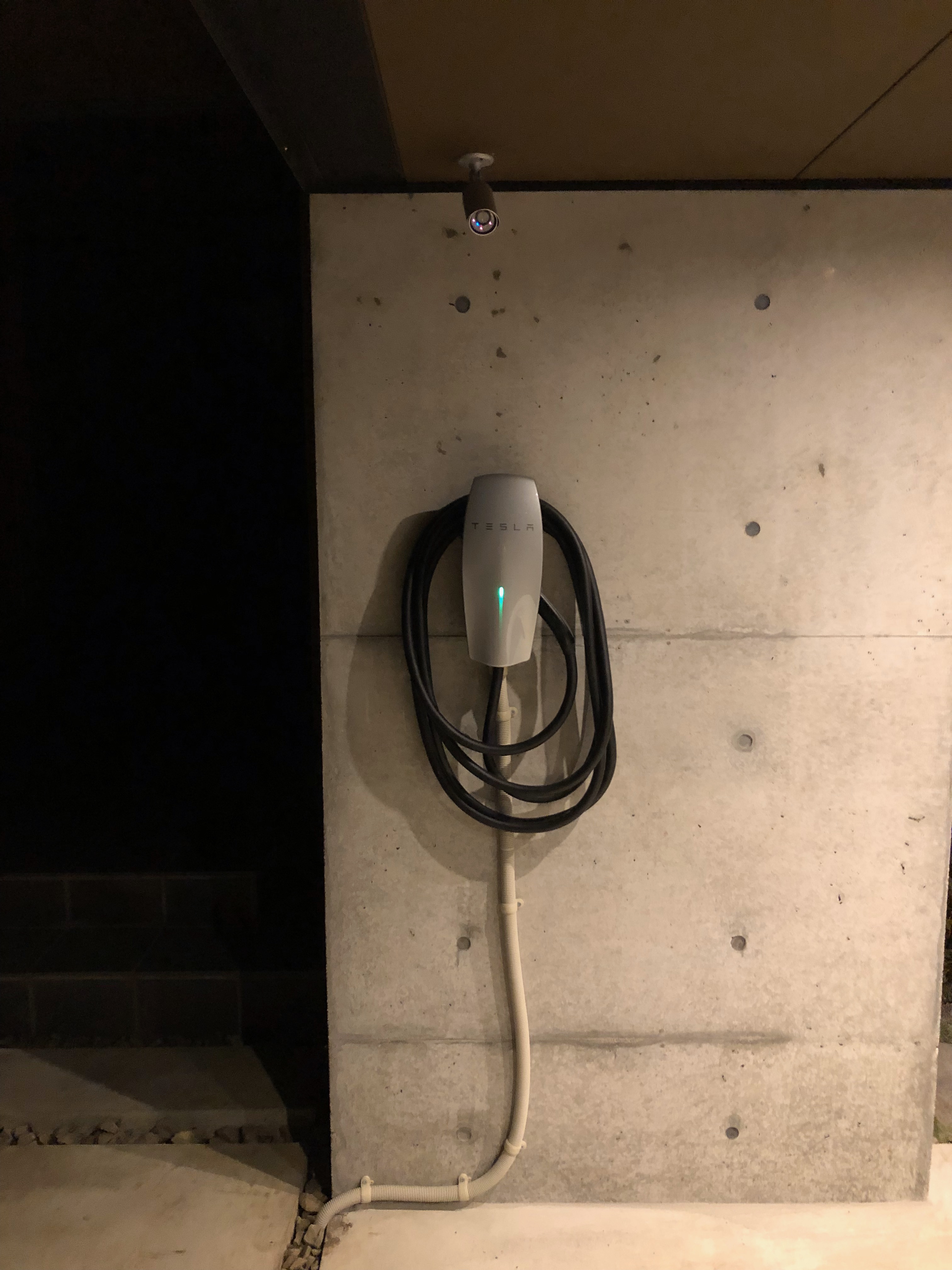
Examples of wall mounting, dedicated stands, and exterior finishes. If you are concerned about wall penetrations or warranties, please start with the explanation of wall mounting and stand installation.

Example installed on the exterior wall of a factory. Since charging at the workplace is mainly during the day, combining it with self-consumption solar lets daytime generation be used directly for charging. The number of units, power receiving equipment, and a preliminary estimate for internal approval are organized through corporate and multi-unit consultations.
The practical checklist by prefecture is on the pages for Tokyo, Gunma, Tochigi, and Ibaraki, and the other prefectures are compiled in the prefecture-by-prefecture list.
AI CHAT FIRST
If you provide the municipality and a reply address, we will return candidate dates for an on-site estimate
A typical installation cost example for one residential unit is around 150,000 to 300,000 yen including tax, excluding the main unit. The formal amount will be determined after an on-site inspection. Photos can be sent later. The person in charge will follow up with whether an on-site visit is possible and candidate dates.
EV CHAT CAMPAIGN
A simple starting point for EV charger consultations
A-CHARGE | An AC standard charging network that provides charging opportunities during parking time


A-Charge®Owners
Standard charging, all parking spaces, just QR.
For parking lot owners: special page, introduction video, and campaign article.
View the special page for owners →A-Charge is being prepared and operated as a charging network that provides opportunities to use AC standard charging during parking time, rather than a service that sets charges based on charging volume. At the Takasaki office, we are conducting pilot operations using a billing platform, and we accept individual consultations with installation owners, facility operators, and construction and maintenance partners.
- Charging opportunities, not charging amount: We design standard AC charging for visitors, employees, and company vehicles according to the parking and stay time at the facility.
- Multiple-unit installation and load balancing: We check the contracted capacity and power receiving equipment, and consider a configuration that places multiple units in one location on the premise of load balancing.
- Handling long occupancy: By designing pricing according to the time occupied without charging and the parking time, it is easier to discuss an operation that suppresses long occupancy of the charger.
- Keep the facility brand: The driver screen can be aligned with the facility side in logo, facility name, and colors (white label. No additional functions. Pricing is higher than standard and requires consultation).
- Renewable energy coordination: Combinations with battery storage such as self-consumption solar, on-site PPA, and Tesla Powerwall can also be considered according to the facility conditions.
Other language versions: Japanese / English / Simplified Chinese / Playlist
60-second short: Japanese / English / Simplified Chinese
We answer the initial questions that arise when making a parking lot billing-ready, one question per page. We list only our own investment amounts and do not include revenue forecasts.
- Can a monthly parking lot be converted to time-based parking without installing a payment machine or lock plate?—Only the space QR code and cameras. Entry is possible from vacant spaces or spaces under contract renewal.
- How much does it cost per parking space to turn idle land into a paid parking lot?—With camera installation, QR code, and paid display, about 100,000 yen per parking space before tax (reference). Chargers are optional.
- To start a coin parking lot, are a payment machine and lock plate necessary?—We compare the items in a conventional estimate with the items in A-Charge. For land with 2 to 3 units.
- What is the difference for a facility among app-based, membership-based, and QR-based EV charging billing methods—the number of steps before the user starts, and the amount of information the facility holds.
- How many EV chargers can be installed without increasing the contracted power—power is automatically allocated within the receiving capacity limit. The number of units is determined by an on-site survey.
- How much it costs to start from an empty parking lot (reference installation price)—three configurations: no charger, adding a standard AC charger, and new service line installation.
Construction inquiries are handled on this page (I-S3), while billing operations are handled at a-charge.jp.
The pricing structure and billing method are individually designed based on installation conditions, operating conditions, payment methods, terms of use, and legal compliance checks. This does not guarantee implementation feasibility, the number of units, cost recovery, or operational effectiveness.
At stores, lodging facilities, and business sites, charging equipment for visitors, employees, and company vehicles can improve convenience and prepare for future EV adoption. At I-S3, we propose practical installation methods tailored to the vehicle model, parking location, distribution board, wiring route, and operating purpose. Combinations with solar PV and Tesla Powerwall can also be discussed as options. First, please send us photos and your requirements via chat.
- At I-S3, many residential EV charger installations are completed through to construction on the same day as the on-site inspection. The more information available in advance, such as photos, installation location, distribution board, preferred model, and parking position, the faster we can make a decision and move toward same-day installation.
- If distribution board modifications, contract capacity changes, long-distance wiring, exterior work, or special wall surfaces or buried conduit are required, we will explain the work details and schedule in advance before proceeding.
- If you have photos of the parking area, distribution board, wiring route, and the charger you want to install, it will be easier to estimate the preliminary cost and understand the scope of work. The final decision will be made after an on-site inspection.
- Our main service areas are Kanto, Koshinetsu, and Fukushima. For Kanagawa, Ibaraki, Tochigi, and Niigata, we can confirm whether support is possible based on the municipality and photos. Detailed guidelines by prefecture are organized on the regional pages.
- For the Nagano area, we review residential and facility projects by condition based on our track record in areas such as Karuizawa, Nagano, and Matsumoto.
- Even outside the main service area, we will individually consider projects such as multiple-unit installations, business sites, apartment buildings, paid charging, and solar PV or PPA integration. Please first let us know the region, number of units, and installation purpose.
- For stores, offices, and apartment buildings, we can also organize preliminary estimates for internal review and approval, the number of units to install, receiving equipment, and items to confirm before the site survey.
- For those who want to proceed rationally, not only based on price, but also including the installation work, technical judgment, and the effort involved in site inspections and attendance.
Related pages:Tesla Wall Connector installation (Gunma, Tochigi, Ibaraki and others) / EV installation in Tokyo, Kanagawa, Saitama, Chiba, Yamanashi, Nagano, Niigata and Fukushima (our own visits) / EV installation in Osaka, Kyoto, Hyogo, Shiga, Nara and Wakayama (partner visits) / Primary information on residential EV charger installation in Kanto and same-day construction / List of construction cases and primary information / Self-consumption solar PV (factories, warehouses, nationwide support) / Repowering (inverter replacement) / Article on same-day EV installation and AI preliminary estimate / Economics of dynamic wireless power transfer (DWPT) while driving on the Tateyama Expressway (research article and video) / Request an on-site estimate without a form
You can consult us via chat instead of a form.
Consultation on Tesla Wall Connector installation
- The main service areas are Kanto, Koshinetsu, and Fukushima. We can consult on everything from a single installation at a private home to multiple units, business sites, apartment buildings, and paid charging projects.
- For Kanagawa, Ibaraki, Tochigi, and Niigata, we first confirm whether a site visit and installation are possible based on the municipality, distribution board, parking location, and preferred model.
- For the Nagano area, we organize the site conditions based on our track record in areas such as Karuizawa, Nagano, and Matsumoto.
- Having photos, the distribution board, parking location, wiring route, and desired model makes it easier to make the AI preliminary estimate more concrete. The final decision is made after an on-site inspection.
- In addition to Tesla vehicles, we can also discuss J1772-compatible vehicles, multi-vehicle charging for stores and workplaces, and combinations with solar PV.
Dwell time and charger type (examples of recommended industries)

FAQ on EV charger installation
What kind of work is needed to charge an electric vehicle at home?
This is electrical work that adds a dedicated 200V circuit to the panelboard and runs wiring to the parking space. What is installed is either a 200V EV outlet for EVs (3 kW or less) or a charger such as a Tesla Wall Connector or J1772 type (6 kW, etc.), and the amount of energy that can be charged in 8 hours is about 24 kWh for an outlet and about 48 kWh for a 6 kW charger. For detached houses, the basic approach is to carry out the work on the day of the on-site inspection, and if panelboard modifications or a change in contracted capacity are required, we will explain this in advance and schedule it for another day. In the six prefectures of Kansai, a partner company will visit, and the schedule and price will be provided by the partner company. Please also see To charge at home.
How does it proceed from request to being able to charge?
If you send your municipality and reply contact by chat, the person in charge will return candidate dates for the visit. On the day of the visit, we confirm the panelboard, wiring route, and installation location, then finalize the amount on the spot and present the estimate (free). If you approve, we proceed with the work immediately, confirm charging start with the vehicle connected, and hand over the installation. More than 99.9% of residential jobs are completed on the day of the site inspection, and charging can start that night. Payment is normally by bank transfer within two weeks after completion. For the six prefectures in Kansai, a partner will visit, and the schedule and amount will be provided by the partner.
Can subsidies be used for installing EV chargers and EV outlets? Who applies?
Applications for subsidies and grants must be submitted by the customer themselves. I-S3 will provide the documents used for the application, including an estimate, invoice, and receipt that show the breakdown of construction costs, as well as photos before and after the work. The national subsidy for detached houses (one 200V charging outlet, up to 50,000 yen) stopped accepting applications on September 30, 2026. Whether there will be another round can be confirmed in announcements from the Next Generation Vehicle Promotion Center. If you have already applied and are waiting for the grant decision, starting an order or construction before the decision will make it ineligible for the subsidy. Please schedule the visit after you receive the grant decision notice. Tokyo's (Cool Net Tokyo) subsidy for detached houses is an application-after-completion system, with applications made after the work and payment are finished. Even if the work is done on the day of the visit, you can still apply afterward. Applications for fiscal 2026 are accepted until 5:00 p.m. on March 31, 2027, and end once the application amount reaches the budget limit. Eligible equipment is new equipment installed by an individual in an existing detached house in Tokyo (new construction is not eligible), and the conditions include having a solar PV system or a contract for 100% renewable electricity. The subsidy amount is the full equipment cost for charging equipment with communication functions (up to 300,000 yen per unit), and 25,000 yen per unit for other equipment. Models are limited to those approved as eligible for subsidies by the Next Generation Vehicle Promotion Center, and it is also a condition that no subsidy has been received from the national government or another local government for the same equipment. Prefectural and municipal programs differ in their conditions and timing by local government, and they end before the deadline once the budget is reached. Please check the page of the local government for the installation address. (As of November 19, 2026) Please also see How to proceed by building type.
Can you provide a preliminary estimate from photos alone?
Yes. If you have photos of the parking location, distribution board, wiring route, and the desired model, our AI chat can organize the preliminary cost and points to confirm. A Google Maps address or pin is also helpful. The final decision will be made with an on-site check during weekday business hours if necessary.
Can you come for the site survey at night?
On-site surveys are basically conducted during weekday business hours, Monday to Friday, and we do not accept evening or nighttime appointments. As a rule, we are closed on Saturdays, Sundays, statutory holidays, and national holidays, except in special cases. If you provide candidate dates, we will coordinate internally and contact you. Even if weekday daytime is difficult, we can provide a preliminary estimate and organize the conditions remotely if you have photos and Google Maps.
Can you conduct an on-site survey on weekends and public holidays?
As a rule, we are closed on Saturdays, Sundays, statutory holidays, and national holidays, except in special cases. The standard schedule for on-site surveys is during weekday business hours, Monday to Friday. If you provide candidate dates, we will coordinate internally, including whether an exception is possible, and contact you. We do not confirm visit dates in chat.
Can Tesla Wall Connector be installed?
Yes. Wall-mounted and stand installation, 200V circuit confirmation, and dedicated wiring are all supported. For details, please also see the Tesla Wall Connector installation page.
If holes or screws are made in the exterior wall, do waterproofing, airtightness, and the manufacturer warranty disappear?
If the penetration and fixing are appropriate, the impact is practically very small, and it is almost never an issue in warranty operations. The standard is wall-mounted on the exterior wall plus proper sealing at the penetration. If you still have concerns, you can choose an option that avoids the exterior wall, such as a pole or column, or start after confirming with the manufacturer. See the explanation of wall mounting and stand installation for details.
Is same-day installation really possible?
For homes, more than 99.9% are installed on the same day as the on-site inspection. If special work such as distribution board renovation is required, we explain it in advance.
What steps do you take, and in what order, on the day of the visit?
After arrival, we check the main breaker capacity and spare circuits in the distribution board, the parking position, the wiring route, and the wall material, then finalize the price on the spot and present a written estimate (free of charge). If you approve, we continue with installation of a dedicated 200V circuit, wiring, waterproof treatment for wall penetrations, and fixing of the unit, then connect the vehicle, confirm charging starts, and hand it over. If distribution board modifications or a contract capacity change are needed, we explain a separate schedule and scope at that point. See also the flow on the day of the visit.
What areas do you cover?
Tokyo, Kanagawa, Saitama, Chiba, Ibaraki, Tochigi, Gunma, Yamanashi, Nagano, Niigata and Fukushima are served by our own visits. Kyoto, Osaka, Hyogo, Shiga, Nara and Wakayama are served by partner visits (17 prefectures in total). Please also refer to the explanation by prefecture above.
What is needed for an AI preliminary estimate?
If you have photos of the parking area, distribution board, wiring route, the charger you want to install, and the exterior of the building, it will be easier to estimate the preliminary cost and understand the scope of work. The final conditions will be confirmed after an on-site inspection.
Can I get advice faster than through the inquiry form?
Yes. In chat, the AI reads the photos you send on the spot, organizes preliminary costs and points to confirm, and can even move on to discussing a visit schedule. Anonymous inquiries, photo-only submissions, and nighttime messages are also supported.
Can you handle comparative quotes and price comparisons with other companies?
We do not deny the act of comparing prices itself. We do not conduct site surveys or free estimates for the purpose of comparing quotes. We visit on the premise of carrying out the work, so the estimate on site is free. Based on the information you provide in advance, we confirm the installation conditions and, if we can respond, we aim to complete the work on the same day. We do not promise same-day installation for every project. We keep travel and sales effort for estimates to a minimum and spend the cost on the work itself. Depending on the region and the work conditions, if a nearby contractor can respond more efficiently, we may explain this and guide you accordingly.
How much does the installation cost?
In a typical single-home case, the charger unit is separate, and the installation cost is about 150,000 to 300,000 yen including tax. There are examples of about 150,000 yen for wall mounting with 10 m of wiring and one wall penetration, about 220,000 yen with stand installation and a contract capacity change, and about 300,000 yen with 25 m of wiring, a contract capacity change, and breaker replacement. See the cost guide for the breakdown.
How much does it cost to install a standard AC charger (6 kW)?
For residential standard AC chargers (AC, roughly 6 kW), the installation cost, excluding the unit, typically ranges from about 150,000 to 300,000 yen including tax. What changes the price is not the model, but the wiring distance, wall penetration, changes to contract capacity, and whether a stand is needed. After choosing a model on the official website, you can request only the installation work. I-S3 is a Tesla-recommended contractor, on-site estimates are free, and same-day installation is standard. Please also see installation cost for a standard AC charger.
Can I request only EV outlet installation work? How is the cost determined?
Yes. We also handle work for EV 200V outlets (3 kW or less) only. The cost is determined less by whether it is an outlet or a charger than by wiring distance, wall penetration, whether the contracted capacity must be changed, and whether a stand is needed; we apply the conditions on site and confirm the price then and there (our own service area, free estimate). If you have photos of the distribution board and parking location before the visit, we can sort out the preliminary estimate and whether same-day installation is possible in advance. See also EV outlet installation.
What conditions change the estimate amount?
The wiring distance from the distribution board to the parking space, the number of wall penetrations, whether attic wiring or buried conduit is needed, whether a contract capacity change or main breaker replacement is required, and whether a dedicated stand (pole) is needed. Differences by model are small, and these five points determine almost everything. If you have photos of the distribution board and parking space, we can confirm in advance which conditions apply.
Can you provide a preliminary estimate using a per-W or per-kW unit price, or a uniform standard installation fee?
We do not set a uniform unit price. Even with the same charger, installation costs vary by about 150,000 to 300,000 yen depending on wiring distance, spare capacity in the distribution board, whether a contract capacity change is needed, and whether wall penetration or a pole is required. With a uniform unit price, that range would be added to everyone’s price. Because we decide the work content for each site, we can install it at the minimum necessary cost by omitting unnecessary work. See our policy on unit prices and estimates.
Can you come for an on-site survey first only? Will the estimate be provided on the spot?
We do not visit only to survey a site or to prepare a quote. When we visit in order to install, we settle the work and the price on site and hand you the quote then. The on-site quote is free, and a same-day discount applies if we install that day. When the job allows it we aim to install the same day, but that is not a promise for every site. This does not mean we skip the on-site checks a safe installation needs. If a nearer contractor can do the work more efficiently, we explain that and may introduce them. Photos of the panel and the parking position, plus the city or ward, let us sort out before the visit whether installation can go ahead that day.
Can you also consult on condominiums, apartment buildings, or mechanical parking systems?
Yes, we can consult. For apartment buildings, the source of power (exclusive area or common area), wiring route, whether billing is needed, and approval from the management association determine whether installation is possible, so each case must be reviewed individually. We will organize and return the confirmation items to submit to the management association (installation location, power source, wiring route, cost burden, and whether billing is required).
See the guideline by prefecture
| Main areas for in-house visits | Tokyo, Kanagawa, Saitama, Chiba, Ibaraki, Tochigi, Gunma, Yamanashi, Nagano, Niigata and Fukushima |
|---|---|
| Outside the main service area | A single unit at a private home is usually outside our direct on-site service area. Multiple units, business sites, apartment buildings, paid charging, solar PV integration, and large A-Charge projects are individually assessed depending on conditions. |
I-S3 Co., Ltd.
379-0136 638-3 Mine, Annaka City, Gunma Prefecture (Head Office) Takasaki Office: 1311-1 Iizuka-machi, Takasaki City, Gunma Prefecture 370-0069
TEL/FAX: 027-381-6583
s_masuda@i-s3.com
For EV inquiries, use chat (no form required).

Promote our Facebook page as well |
|
All rights reserved by I-S3
|
I-S3 Co., Ltd.
379-0136 638-3 Mine, Annaka City, Gunma Prefecture (Head Office) Takasaki Office: 1311-1 Iizuka-machi, Takasaki City, Gunma Prefecture 370-0069 TEL/FAX: 027-381-6583 |